
What you’ll learn in this article…
- Bellevue University is the top-ranked Nebraska-based online cybersecurity program for 2026 in our analysis.
- Nebraska cybersecurity salaries often exceed national medians, driven by defense, finance, and healthcare employers.
- Programs embedding CompTIA Security+, CEH, and CISSP prep into coursework can save students hundreds in separate exam costs.
- BLS projects double-digit job growth for information security analysts, making Nebraska a strong market for new graduates.
Omaha is home to USSTRATCOM, a growing cluster of defense contractors, and major financial institutions like Mutual of Omaha and First National Bank. That concentration fuels steady cybersecurity hiring in a state where information security analyst roles are projected to grow well above the national average through 2032. Yet Nebraska has a relatively small pool of in-state online cybersecurity programs, which means residents often weigh a single local option against dozens of out-of-state online degrees.
The real question is whether a Nebraska-based program delivers better career ROI than a nationally available alternative, once you factor in tuition, CAE designation status, embedded certifications, and regional employer relationships. Below, we break down the ranked programs, explain our methodology, and walk through the cost, salary, and job market data you need to make that call.
Best Online Cybersecurity Programs in Nebraska: 2026 Rankings
These rankings prioritize online accessibility alongside outcome metrics such as institutional graduation rates, net price, and graduate earnings. Because Nebraska's online cybersecurity landscape is focused rather than sprawling, this list highlights the program that combines strong online delivery, career-changer support, and recognized quality credentials. Bellevue University stands out as the state's premier option for earning a cybersecurity degree entirely online.
- Online delivery and flexibility
- Institutional graduation and retention
- Net price and student debt levels
- Graduate earnings outcomes
- Workforce framework alignment
- Independent program research
- Internal program database
- NCES-IPEDS federal institutional data — nces.ed.gov
- College Scorecard graduate earnings — collegescorecard.ed.gov
- #1
Bellevue University
Bellevue, NE · ~$18,000/yr (est.)
Best for: Career changers entering cybersecurity from IT
Bellevue University is a private institution in Bellevue, Nebraska, with deep ties to Midwest employers and defense organizations near Offutt Air Force Base. The university holds an NSA/DHS CAE designation, underscoring its commitment to cybersecurity education quality. With a 12:1 student-to-faculty ratio and robust 24/7 online tutoring and tech support, Bellevue caters especially well to working professionals and career changers pursuing graduate cybersecurity credentials remotely.
View program
- Cohort-based, fully online program with 36 credit hours
- $680 per credit for the 2025/2026 academic year
- No GMAT or GRE required for admission
- Requires bachelor's degree with minimum 2.5 GPA and 3+ years IT experience
- Curriculum aligned with the NICE Cybersecurity Workforce Framework
- Updated coursework covers cloud security, DevSecOps, and GRC
- Integrates CompTIA Security+ and CySA+ certification preparation
- Dedicated Student Coach support and collaborative cohort learning
How We Ranked Nebraska's Online Cybersecurity Schools
Transparency matters when you are making a decision as significant as choosing a degree program. Many ranking lists you will find online offer little clarity on how schools were selected or scored. We take a different approach, walking you through exactly what goes into our composite scores so you can evaluate our recommendations with confidence.
What Goes Into the Composite Score
Every program in our 2026 rankings receives a composite score built from several baseline quality factors and a boost for robust online delivery. The core inputs include:
- Net price: We use a sector-conditional average of what students actually pay after grants and scholarships, giving you a realistic picture of out-of-pocket cost rather than sticker price.
- Graduation rate: This metric reflects how well an institution supports students through to completion. It is worth noting that graduation rates are reported at the institution level, not for individual cybersecurity programs, so they represent the broader campus environment rather than a single department.
- Post-graduation earnings: Where program-level outcome data is available, we factor in what graduates earn after completing their degree. When program-specific earnings have not yet been published, we rely on institution-wide figures and note that limitation.
- Online delivery quality: Programs that offer a fully online or primarily online format with strong student-support infrastructure receive additional weight, since flexibility is often a top priority for career changers and working professionals.
Where the Data Comes From
Our analysis draws on federally maintained data from IPEDS and the College Scorecard, two of the most comprehensive and regularly updated higher-education datasets available. We supplement these with program-level outcome data where it has been released. When a data point is not available for a particular school or program, we say so plainly rather than filling the gap with estimates.
Why This Matters for You
Most search results ranking cybersecurity programs in Nebraska provide little or no explanation of how they arrived at their lists. Some rely on editorial opinion alone or on a single metric like tuition. Our multi-factor approach is designed to balance affordability, academic quality, and career outcomes, giving you a more complete picture. We apply the same methodology across all of our best online cybersecurity programs, so you can compare Nebraska schools against a consistent national benchmark. Being upfront about what the data can and cannot tell us, such as the institution-wide nature of graduation rates, helps you weigh the rankings appropriately rather than treating any list as the final word.
Use our rankings as a strong starting point, then dig deeper into the programs that catch your eye. The schools on our list earned their spots through measurable performance, not paid placement.
Questions to Ask Yourself
Cost and ROI of Online Cybersecurity Degrees in Nebraska
Understanding what you will actually pay for an online cybersecurity degree, and what you can expect to earn afterward, is the single most practical step you can take before committing to a program. Nebraska-based and Nebraska-serving online programs span a wide price range, so looking beyond sticker price is essential.
What Programs Actually Cost
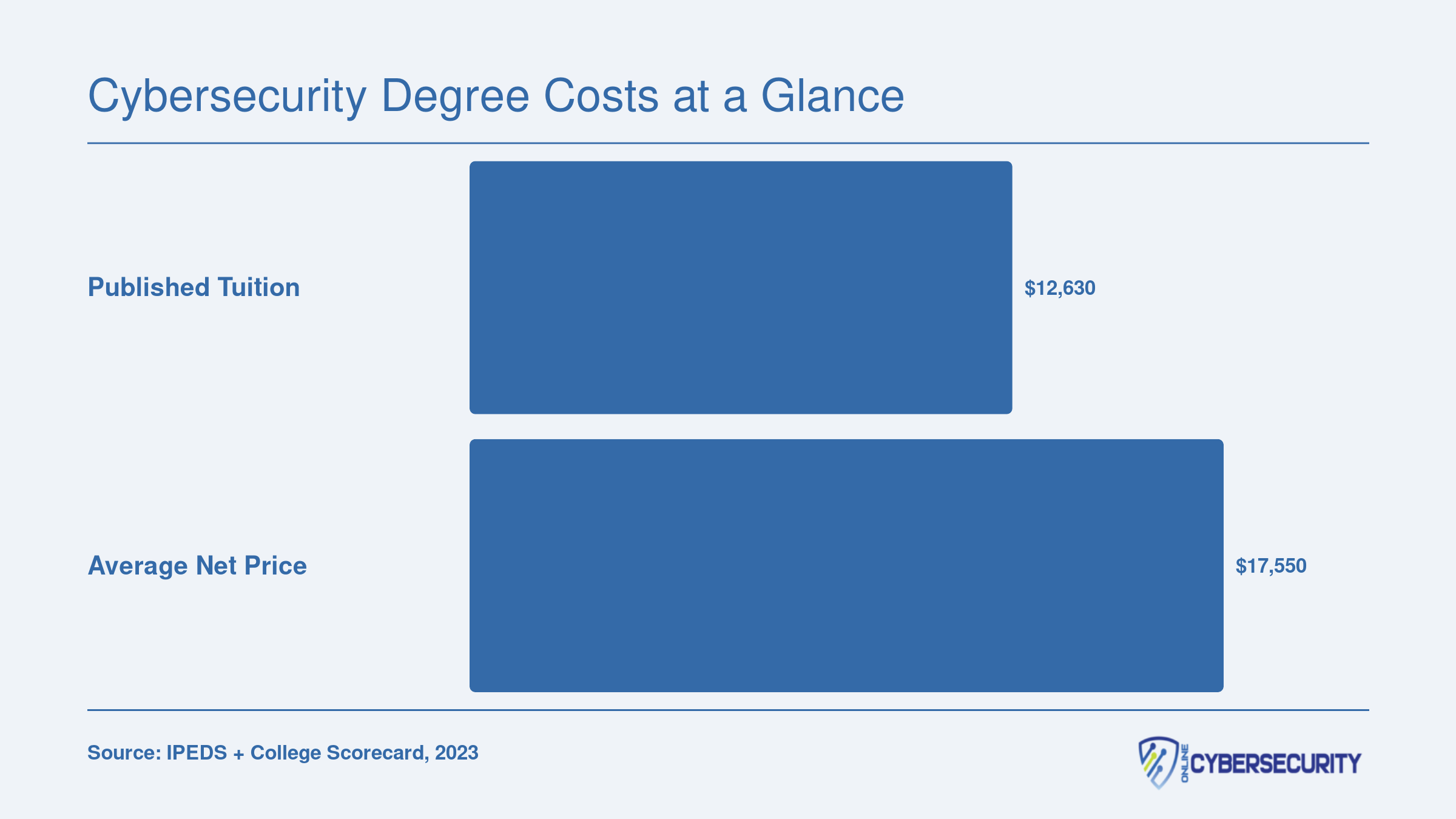
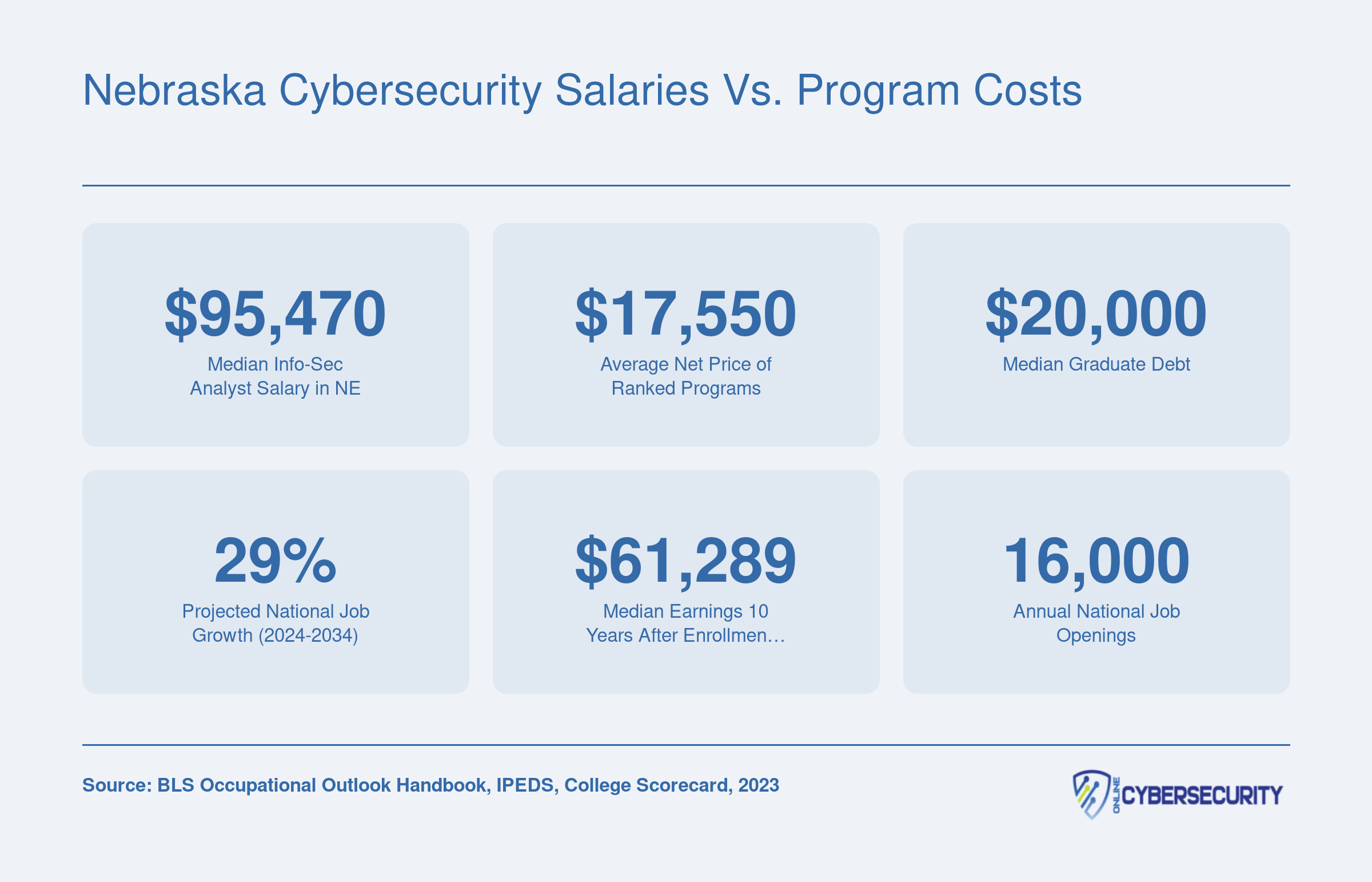
Published tuition is only part of the picture. Net price, the amount students pay after grants and scholarships, can be significantly lower. For example, Bellevue University lists its online Master of Science in Cybersecurity at roughly $12,630 in total tuition (36 credit hours at $680 per credit), while its institution-level average net price sits around $17,550 for students receiving aid. Keep in mind that net price figures reflect an institution-wide average across all programs and student profiles. Your individual cost will depend on the financial aid package you receive, including federal grants, institutional scholarships, and employer tuition benefits. If you are weighing speed alongside cost, fastest online cybersecurity degree options can also reduce total expenses by shortening time to graduation.
Measuring Return on Investment
ROI in education comes down to a straightforward comparison: what you borrow versus what you earn after graduation. Bellevue University graduates across programs report median earnings of about $61,289 ten years after enrollment, with a median graduation debt near $20,000. That relationship yields a strong return, with graduates earning roughly three times their debt load over the longer term. Program-level earnings data for individual cybersecurity degrees at Nebraska schools are not yet available in every case, so when comparing options, use institution-wide outcomes as a starting benchmark and supplement them with employer salary surveys for roles you are targeting.
Nebraska-Specific Ways to Lower Your Cost
Several financial aid paths can reduce what you owe, and they are easy to overlook if you only compare tuition tables.1
- Nebraska Opportunity Grant: Available to Nebraska residents enrolled at least half-time at eligible institutions.2 You generally need to be Pell-eligible, and deadlines vary by school (as early as April 1 at Wayne State College, May 1 at others).34 The grant applies to online programs when the institution and program qualify.2
- Nebraska Promise: Covers tuition gaps for families earning $65,000 or less. You must maintain a 2.5 GPA and enroll full-time (12 or more credits). Online programs billed at regular tuition rates can qualify.
- Susan T. Buffett Scholarship: One of the most generous awards in the state, covering tuition, fees, and potentially books and housing. Eligibility requires Nebraska residency, a Nebraska high school diploma, and attendance at a Nebraska public college.6
- Midwest Student Exchange Program (MSEP): Caps tuition at 150 percent of in-state rates for students attending participating schools in other MHEC states. Verify directly with the institution whether the discount extends to fully online programs, as policies vary.
- Federal Pell Grant and FSEOG: Both are usable at accredited online programs. Filing the FAFSA early improves your chances for limited-fund awards like the Federal Supplemental Educational Opportunity Grant.
Nebraska also participates in the State Authorization Reciprocity Agreement (SARA), which simplifies enrollment at out-of-state online schools. SARA itself does not set tuition rates or provide discounts, but it does remove regulatory barriers that might otherwise prevent you from accessing a broader set of programs.
Putting It All Together
Before you compare program brochures, run your own numbers. Start with the net price calculator on each school's financial aid page, factor in any state grants you qualify for, and weigh projected debt against realistic salary expectations in your target cybersecurity role. A degree that looks expensive at sticker price may become the most affordable option once Nebraska-specific aid is applied, and one that looks cheap may carry hidden fees. The next section breaks down those cost figures side by side so you can compare at a glance.
Cybersecurity Degree Costs at a Glance
Bellevue University is currently the only Nebraska-based institution offering a ranked online cybersecurity program in our 2026 analysis. Because it is a private university, tuition is the same regardless of residency. The net price shown is an institution-wide average and actual costs will vary by student based on financial aid, scholarships, and enrollment status.
Cybersecurity Degree Levels Available in Nebraska
Nebraska offers several pathways into cybersecurity education, and the right one for you depends on where you are in your career, how much time you can invest, and what role you want to land. Here is a breakdown of each degree level, what it prepares you for, and how long it typically takes.
Certificates: The Fastest On-Ramp
Cyber security certificate programs usually take between four and twelve months to complete and are ideal for career changers who already hold some IT experience. They focus on practical, job-ready skills such as network defense, ethical hacking, or security operations. If you are transitioning from help-desk or systems-administration work, a certificate can quickly validate your cybersecurity knowledge and help you break into entry-level roles like security analyst or incident responder.
Associate Degrees: Building the Foundation
An associate degree in cybersecurity generally requires about two years of full-time study. These programs cover foundational topics like operating systems, networking, and introductory security principles. Graduates are well positioned for junior roles in IT security or can transfer credits toward a four-year degree.
Bachelor's Degrees: The Most Common Entry Point
A bachelor's degree remains the most widely requested credential for SOC-analyst and security engineer career path positions. Expect roughly four years of full-time coursework, though accelerated options can shorten that timeline. Programs at this level dive deeper into risk management, digital forensics, secure software development, and compliance frameworks. To learn more about typical cybersecurity coursework, exploring program breakdowns can help set expectations. For most employers in Nebraska and beyond, a bachelor's degree checks the baseline education box and pairs well with industry certifications.
Master's Degrees: Advancing into Leadership
A master's degree is where the path shifts from hands-on technical work to strategic leadership. These programs typically require 18 to 24 months and prepare graduates for management roles, security architecture positions, and CISO tracks. Among the ranked Nebraska programs, Bellevue University offers an online Master of Science in Cybersecurity, a cohort-based program of 36 credit hours that does not require GMAT or GRE scores. Applicants should hold a bachelor's degree with a minimum 2.5 GPA and ideally bring three or more years of IT experience.
Choosing Your Level
Consider these factors when deciding which degree level fits best:
- Current experience: If you already work in IT, a certificate or master's program can accelerate your move into cybersecurity without starting from scratch.
- Time commitment: Certificates offer speed, while bachelor's and master's programs offer depth and broader career flexibility.
- Career goal: Entry-level analyst roles often require a bachelor's degree at minimum, while director and executive security roles increasingly expect a graduate credential.
- Budget: Shorter programs carry lower total costs, but higher-level degrees tend to produce stronger long-term earnings.
Matching your degree level to your goals and timeline is one of the most impactful decisions you will make in your cybersecurity education journey.
Accreditation and CAE Designation for Nebraska Programs
Accreditation is one of the fastest ways to separate a rigorous cybersecurity program from a questionable one. Before you commit tuition dollars, understanding the different layers of accreditation will help you make a confident choice.
Regional and Programmatic Accreditation
Regional accreditation (now referred to as institutional accreditation by agencies like the Higher Learning Commission) is the baseline stamp of quality for any college or university. It confirms that the institution meets established academic standards, and it is a requirement for students to receive federal financial aid. Employers treat a regionally accredited degree as legitimate; without it, your credential may not be recognized during a background or education check.
Programmatic accreditation goes a step further. Organizations like ABET accredit specific computing and engineering programs, while AACSB focuses on business schools. A cybersecurity or information assurance program carrying ABET accreditation signals that the curriculum, faculty qualifications, and learning outcomes have been independently evaluated against industry-aligned criteria. Hiring managers in defense, finance, and healthcare often look for this distinction.
NSA/DHS CAE-CD Designation in Nebraska
The Centers of Academic Excellence (CAE) for Cybersecurity designation is granted by the National Security Agency and the Department of Homeland Security to programs that meet a demanding set of cybersecurity knowledge units.1 It matters for two big reasons: it validates the depth of the curriculum, and it opens doors to exclusive scholarships and programs such as CyberCorps Scholarship for Service (SFS), which covers tuition in exchange for a commitment to work in a government cybersecurity role after graduation.
As of 2026, Nebraska has two institutions holding active CAE-CD designation:2
- Bellevue University: Designated at the bachelor's and master's levels. Originally designated in 2014, Bellevue has renewed its status and remains active through the current cycle.
- University of Nebraska at Omaha: Also designated at the bachelor's and master's levels. UNO earned its initial designation in 2014 and has likewise renewed, maintaining active status today.
Nebraska currently has no community colleges with a CAE designation at the associate level, which means students pursuing a two-year pathway will want to confirm that credits transfer smoothly into one of the CAE-designated four-year programs listed above.2
SARA Authorization and Out-of-State Online Students
If you are a Nebraska resident considering an online program based in another state, or an out-of-state student eyeing a Nebraska school, look for SARA (State Authorization Reciprocity Agreement) participation. Nebraska is a SARA member, which means its approved institutions can legally enroll online students across state lines without seeking separate authorization in each state. This simplifies enrollment and protects you from inadvertently enrolling in a program that lacks authorization to operate where you live. Always verify SARA participation on a school's admissions page before applying.
The best online cybersecurity programs in Nebraska weave industry certification prep, including CompTIA Security+, Network+, CEH, and CISSP, directly into their coursework. This can save you weeks of separate study and hundreds of dollars in exam prep costs. When comparing programs, ask each admissions office which certifications are embedded in the curriculum. It is one of the most practical differentiators between otherwise similar degrees.
Nebraska Cybersecurity Job Market and Career Outlook
Nebraska's cybersecurity job market is stronger than you might expect for a midsize state, driven by a unique mix of defense installations, financial services headquarters, and a growing healthcare technology sector. If you are weighing an online cybersecurity degree here, the employment picture should factor heavily into your decision.
Salary Snapshot for Information Security Analysts
In the Omaha-Council Bluffs metro area, information security analysts earned a median annual wage in the range of $110,000 to $115,000 as of the most recent Bureau of Labor Statistics data.1 Wages at the 25th percentile fell between $90,000 and $95,000, while those at the 75th percentile reached $130,000 to $135,000. That puts Omaha salaries within competitive range of the national median of roughly $124,910.3 Statewide, the median was lower at about $84,066, reflecting the wage gap between metro hubs and rural areas.2 Even so, Nebraska's lower cost of living means take-home purchasing power often rivals what analysts earn in higher-cost coastal markets.
The Omaha metro employed approximately 550 information security analysts, and the location quotient of 1.13 signals that cybersecurity jobs are slightly more concentrated here than in the average U.S. metro.1 Statewide employment topped 750 positions, with nearly 39 percent of those roles housed in professional, scientific, and technical services firms.2
Who Is Hiring in Nebraska
The state's employer landscape spans several high-demand sectors:
- Defense and government: U.S. Strategic Command (USSTRATCOM) at Offutt Air Force Base and the 55th Wing create steady demand for cleared cybersecurity professionals, along with defense contractors operating in the Omaha metro.
- Financial services: Mutual of Omaha and Union Pacific both maintain large IT security teams to protect critical financial infrastructure.
- Education and lending: Nelnet, headquartered in Lincoln, handles billions in student loan servicing and needs robust cyber defenses.
- Healthcare: Nebraska Medicine and affiliated health systems invest in cybersecurity talent to safeguard patient data and comply with federal regulations.
This employer diversity means graduates are not dependent on a single industry cycle for job opportunities.
Growth Projections and Local Demand
Nationally, the Bureau of Labor Statistics projects a 29 percent growth rate for information security analysts|from 2024 to 2034, far outpacing the average for all occupations.3 Nebraska's combination of defense spending and financial sector presence positions the state to match or exceed that pace locally. Offutt AFB alone anchors billions in defense-related economic activity, and the financial institutions headquartered in Omaha continually expand their security operations as digital threats evolve.
How Program Graduates Stack Up
When evaluating Nebraska's online cybersecurity programs, it is worth noting that program-level earnings data is not yet available for every school in the state. For programs where early-career and mid-career graduate earnings have been published, those figures provide useful context when compared against the statewide and metro-area medians listed above. A graduate who lands in the Omaha market can reasonably target a six-figure salary within a few years of completing their degree, particularly if they pair it with industry certifications and hands-on experience. Bellevue University, located just outside Omaha and near Offutt AFB, offers an online Master of Science in Cybersecurity with tuition of roughly $680 per credit hour, positioning graduates to pursue the defense and corporate roles that dominate the local market.
The bottom line: Nebraska's job market rewards cybersecurity credentials with competitive salaries, a healthy concentration of employers, and growth momentum that shows no sign of slowing through the end of the decade.
Nebraska Cybersecurity Salaries vs. Program Costs
How does your investment in a Nebraska cybersecurity degree stack up against what you can expect to earn? This snapshot puts program costs side by side with salary data and job growth so you can evaluate ROI at a glance.
Tips for Choosing an Online Cybersecurity Program in Nebraska
Picking the right online cybersecurity program is a big decision, especially if you are balancing a career change with work or family obligations. These five tips will help you compare Nebraska options (and out-of-state online programs) on the factors that matter most.
Look for Embedded Certification Prep
Industry certifications like CompTIA Security+, Network+, and CEH can open doors faster than a degree alone, but preparing for them separately costs hundreds of dollars in courses and exam fees. Some Nebraska programs bake that prep right into the curriculum. Western Nebraska Community College's Associate of Arts in Cybersecurity, for example, integrates CompTIA A+, Network+, Security+, and Linux+ prep and even covers exam fees and practice tests.1 Southeast Community College's online cybersecurity bootcamp also bundles a CompTIA exam voucher and study materials.2 When you compare programs, ask specifically whether certification prep is woven into coursework and whether exam vouchers are included.
Verify SARA Authorization and MHEC Reciprocity
If you are considering an out-of-state online program, confirm that the school participates in the State Authorization Reciprocity Agreement (SARA) and, ideally, the Midwestern Higher Education Compact (MHEC). These agreements can substantially lower tuition for Nebraska residents enrolling in programs outside the state. Without them, you may face out-of-state surcharges or discover the program cannot legally enroll you. For perspective on how other states handle reciprocity for cybersecurity students, our guide to online cybersecurity degree Colorado covers a similar SARA landscape.
Evaluate Flexibility for Working Adults
Not all "online" programs are created equal. Before you enroll, dig into the details:
- Asynchronous vs. synchronous: Asynchronous coursework lets you study on your own schedule, while synchronous classes require you to log in at set times.
- Prior-learning assessment: Some schools award credit for professional experience or military training, potentially shaving a semester or more off your timeline.
- Transfer credit policies: If you already hold an associate degree or have completed IT coursework elsewhere, generous transfer policies keep you from repeating material you already know.
These factors can be the difference between finishing a program and dropping out, so treat them as essentials rather than nice-to-haves.
Check for CAE-CD Designation
The National Security Agency's Centers of Academic Excellence in Cyber Defense (CAE-CD) designation signals that a program meets rigorous federal curriculum standards. In Nebraska, both the University of Nebraska at Omaha and Bellevue University hold this designation.3 Beyond academic quality, CAE-CD status can unlock CyberCorps Scholarship for Service (SFS) funding and give graduates a hiring preference for certain federal cybersecurity roles. If government or defense-sector work interests you, this designation is worth prioritizing.
Compare Net Price, Not Sticker Price
Tuition listed on a program page rarely reflects what you will actually pay. File the FAFSA early, then use each institution's net price calculator to estimate your real cost after grants, scholarships, and employer tuition assistance. Two programs with very different sticker prices can end up costing nearly the same once aid is factored in. Focusing on net price keeps you from ruling out strong programs prematurely or overpaying for a degree that looked affordable on the surface.
Frequently Asked Questions About Online Cybersecurity Degrees in Nebraska
Choosing an online cybersecurity program is a big decision, especially if you are changing careers or returning to school. Below are answers to the questions Nebraska students ask most often, grounded in current program data and labor market information.