

What you’ll learn in this article…
- NSA and DHS CAE designation signals genuine program quality and is held by many of the top ranked schools.
- Tuition for an online cybersecurity master's ranges roughly from $15,000 to over $70,000 depending on residency.
- The global cybersecurity workforce gap has reached approximately 4.8 million unfilled positions as of 2024 data.
- Graduates from highly ranked programs often see ROI ratios well above breakeven within ten years of enrollment.
The global cybersecurity workforce gap now exceeds 4.8 million unfilled positions, according to ISC2's 2024 study, and employer demand for master's-level candidates continues to outpace supply heading into 2026. For IT professionals and career changers alike, an online master's in cybersecurity offers a direct path to senior roles in security architecture, incident response leadership, and risk management, all without requiring a relocation or career pause.
The practical tension is real: program costs range from under $15,000 to well over $60,000, CAE designations vary in scope, and not every degree delivers the same earning power. Programs ranked here are ordered by a quality composite that weighs graduate outcomes, institutional resources, and debt levels rather than simply sorting by price or completion speed. Median earnings for cybersecurity master's holders frequently clear six figures within a few years of graduation, but the gap between top-performing and middling programs is wider than most applicants expect. Whether you are a security analyst looking to level up or a career changer exploring your first graduate credential, the right program choice makes a measurable difference.
Best Online Master's in Cybersecurity: Ranked Programs
The programs below are sorted by a quality composite that weighs institutional outcomes, faculty resources, graduate debt levels, and earning power, with an additional boost for programs that can be completed entirely or mostly online. The result is a list that rewards both academic rigor and the flexibility working professionals actually need.
- #1
Thomas Edison State University
Trenton, NJ · $5,000 – $10,000/yr
Best for: Working adults seeking minimal student debt
Thomas Edison State University is purpose-built for working adults, offering a fully online, asynchronous 30-credit M.S. in Cybersecurity that can be started at multiple points throughout the year. The curriculum spans network security, cryptography, digital forensics, and cyber-risk management, all delivered through cloud-based virtual labs so students never need special local hardware. With the lowest median graduate debt on this list and strong institutional earnings, TESU stands out for learners who want a respected public-university credential without relocating or pausing a career.
View program
- 30-credit fully online program with asynchronous delivery
- Covers network security, cryptography, and digital forensics
- Cloud-based remote labs for all hands-on coursework
- Courses mapped to NICE Cybersecurity Workforce Framework roles
- Bachelor's degree with 3.0 GPA required for admission
- No GRE or GMAT required
- Scholar-practitioner mentors guide applied projects
- Military and federal employee transfer-friendly policies
- #2
University at Albany
Albany, NY · $17,000/yr
Best for: Specialists wanting multiple concentration choices
The University at Albany offers an M.S. in Digital Forensics and Cybersecurity through an interdisciplinary partnership between its business and homeland security colleges. The 36-credit program features five distinct concentrations, giving students the ability to specialize in areas like Cyber Operations, Digital Forensics, or Cyber Security. Courses are delivered in a hybrid format with an increasing share of online sections, and UAlbany holds an NSA/DHS Center of Academic Excellence in Cyber Defense designation that can unlock federal scholarship pipelines.
View 3 programs
- 36-credit hybrid program with growing online course share
- Five cybersecurity concentrations available
- Choose between internship or thesis capstone track
- NSA/DHS CAE-CD designated curriculum
- Interdisciplinary coursework from business and security colleges
- SUNY cross-registration opens elective options
- Focus on offensive and defensive cyber techniques
- Hands-on incident investigation and response training
- Evening and partial-online scheduling for professionals
- Access to SUNY-wide online course sharing
- Federal scholarship eligibility through CAE designation
- 36 credits with internship or thesis option
- Deep dive into evidence collection and forensic analysis
- Prepares graduates for intelligence and law enforcement roles
- Hybrid delivery with increasing online flexibility
- Collaborative capstone with industry or government partners
- Proactive threat management coursework
- Supports DoD Cyber Scholarship Program eligibility
- #3
Northern Arizona University
Flagstaff, AZ · $14,000/yr
Best for: Remote learners near defense sector careers
Northern Arizona University delivers a fully online M.S. in Cybersecurity through its School of Informatics, Computing, and Cyber Systems. The program emphasizes hands-on capstone projects and industry mentorships, giving students more than 200 hours of practical experience they can complete remotely. NAU holds CAE-CD recognition from the NSA/DHS, and its curriculum maps to CompTIA Security+, CySA+, and CISSP competencies, letting students stack certification prep into their degree work.
View program
- Fully online, primarily asynchronous delivery
- 200+ hours of practical, project-based experience
- Choose project-based or research-oriented capstone
- NSA/DHS CAE-CD designated program
- Curriculum aligned with CISSP and CompTIA certifications
- Cloud-based cyber range labs accessible from anywhere
- Remote capstone sponsors from federal and private sectors
- Designed for working professionals with flexible pacing
- #4
West Virginia University
Morgantown, WV · $16,000/yr
West Virginia University's online M.S. in Business Cybersecurity Management blends technical security coursework with governance, risk, and compliance strategy. The 30-credit program runs on 8-week accelerated terms and can be finished in one to two years, with no GRE or GMAT required. Housed in the AACSB-accredited John Chambers College of Business, the degree prepares graduates for CISSP certification and leadership roles like CISO or risk manager through live corporate projects conducted entirely online.
View program
- 30 credits across 10 courses, all online
- 8-week accelerated terms for faster completion
- No GRE or GMAT required for admission
- AACSB-accredited business college credential
- CISSP domain-mapped coursework and exam prep resources
- Live corporate projects with remote industry partners
- Minimum 2.75 GPA with bachelor's degree for entry
- Virtual networking events with CISOs and security leaders
- #5
Middle Tennessee State University
Murfreesboro, TN · $13,000/yr
Middle Tennessee State University offers an M.S. in Cybersecurity Management through its AACSB-accredited Jones College of Business. While officially listed as hybrid, a fully online path is available by selecting online sections of required courses, making it practical for working professionals across Tennessee and beyond. The curriculum blends risk management, security policy, and incident response with the option to integrate business analytics electives.
View program
- Online path available through online course sections
- AACSB-accredited business school setting
- Covers risk management, security policy, and incident response
- Aligned with NICE Framework management and governance roles
- In-state tuition advantages for Tennessee residents
- Evening and simulcast classes boost scheduling flexibility
- Integrates cybersecurity with IT management electives
- Bachelor's degree and transcripts required for admission
- #6
Kennesaw State University
Kennesaw, GA · $15,000/yr
Kennesaw State University's 100% online M.S. in Cybersecurity is built around a cohort model with 7-week courses, enabling prepared students to graduate in as little as 12 months. The 30-credit program uses cloud-based cyber ranges for penetration testing and defense labs, so students need no specialized hardware at home. Located within Georgia's growing cyber ecosystem, including the Augusta cyber hub, KSU holds CAE designation and offers remote capstone practicums with industry partners.
View program
- 100% online with 7-week asynchronous courses
- 12-month accelerated completion possible
- 30 credit hours: 9 core courses plus capstone
- Cloud-based cyber range for hands-on labs
- CAE-designated with strong Georgia cyber industry ties
- Remote capstone practicum option for non-local students
- Minimum 2.75 GPA for admission, no GRE listed
- Aligned with CEH, CISSP, and CompTIA Security+ prep
- #7
University of Arizona
Tucson, AZ · ~$17,000/yr (est.)
The University of Arizona's online M.S. in Cybersecurity is jointly administered by the Eller College of Management and the College of Engineering, offering two distinct tracks: Information Systems (accelerated 7-week courses) and Physical Systems (16-week format covering ICS and hardware security). A flat per-credit rate applies regardless of residency, and six annual start dates give working professionals maximum scheduling control. UA holds both CAE-CD and CAE-CO designations, and students can stack an Enterprise Security Certificate into the full degree.
View 2 programs
- 33-credit fully online program with 7-week courses
- Flat $1,250 per credit regardless of residency
- Six start dates per year for flexible enrollment
- NSA/DHS CAE-CD and CAE-CO designated
- Enterprise Security Certificate stackable into degree
- Virtual labs and simulation tools for all coursework
- Joint Eller College and Engineering College faculty
- Designed for working professionals globally
- Focuses on ICS, hardware, and physical systems security
- 16-week course format for deeper engineering content
- Remote access to virtualized physical systems testbeds
- 33 credits with same flat online tuition rate
- Interdisciplinary curriculum across three departments
- Capstone can be completed remotely with industry sponsor
- CAE-CO alignment supports federal cyber career paths
- Six admission windows per year
- #8
James Madison University
Harrisonburg, VA · $23,000/yr
James Madison University offers a 100% online, asynchronous M.S. in Computer Science with a Cybersecurity concentration. The cohort-based program is designed for working professionals and typically takes about 2.5 years part time. Graduates earn an NSA certificate in Cyber Defense alongside their degree, which adds a federal hiring credential at no extra cost. JMU's strong institutional graduation rate and retention numbers reflect broader academic quality that carries into the online experience.
View program
- 100% online and fully asynchronous delivery
- Cohort-based model builds a professional network
- Part-time or full-time enrollment options
- NSA Cyber Defense certificate included at graduation
- Focus on creating and maintaining secure computing systems
- 250+ successful graduates from the program
- Designed specifically for information security professionals
- Approximately 2.5 years to complete full time
- #9
University of Massachusetts-Lowell
Lowell, MA · $17,000/yr
UMass Lowell delivers two online cybersecurity pathways: an M.S. in Security Studies with a Cybersecurity concentration (blending criminal justice and IT perspectives) and an M.S. in Computer Science with a Cybersecurity option. The Security Studies track can be finished in 18 months at $610 per credit with no GRE required, making it one of the more affordable and fastest options on this list. UMass Lowell holds CAE designation and boasts faculty with active security clearances, adding real-world credibility to its coursework.
View 2 programs
- 10-course, 30-credit fully online program
- $610 per credit, total under $20,000
- Completable in as few as 18 months
- No GRE required for admission
- Combines criminal justice and IT perspectives
- Covers network security, digital forensics, intelligence analysis
- NSA/DHS CAE-designated program
- Faculty hold active security clearances
- 30-credit program with optional master's thesis
- Online and on-campus delivery available
- STEM-OPT eligible for international students
- Core coursework in algorithms and cybersecurity
- No GRE required for admission
- Bachelor's-to-master's accelerated pathway available
- #10
Rowan University
Glassboro, NJ · $22,000/yr (net price)
Rowan University's M.S. in Cybersecurity offers flexible online or in-person pathways with 30 to 31 graduate credits that can be completed in 1.5 to 2 years. Students choose from concentrations like Advanced Cybersecurity Principles and Applications or Cybersecurity Risk Analysis in Homeland Security, giving the program unusual depth for a mid-size public university. Coursework covers cybersecurity fundamentals, network security, management, and electives in advanced topics, and the flat tuition rate applies equally to in-state and out-of-state online students.
View 3 programs
- 30 to 31 credits, completable in 1.5 to 2 years
- Online or in-person delivery options
- Same tuition rate for in-state and out-of-state students
- Fall, spring, and summer entry terms available
- Core courses in management, network security, and defense
- Bachelor's degree with minimum 2.5 GPA required
- Two recommendation letters and statement of objectives needed
- Transfer credit evaluation available
- Concentration in advanced security techniques and tools
- Electives in cutting-edge cybersecurity topics
- 100% online path available
- Builds on core cybersecurity management coursework
- Designed for students pursuing technical specialist roles
- 1.5 to 2 year completion timeline
- Concentration blending cyber risk with homeland security
- Electives in risk analysis and policy frameworks
- Available fully online or on campus
- Prepares graduates for public sector security roles
- Core courses shared with other M.S. tracks
- Supports careers in government and regulated industries
How We Ranked These Programs
Transparency matters. Many ranking lists either hide their methodology behind vague editorial language or lean on a single factor like tuition cost or brand reputation. We take a different approach here at onlinecybersecurity.org, and we want you to see exactly how these programs earned their spots.
Our Composite Scoring Approach
Every program in our ranking runs through a multi-factor quality composite rather than a single headline number. The core inputs include:
- Graduation rate: How effectively the institution guides students to completion.
- Net price: The average out-of-pocket cost students actually pay, adjusted by institution sector (public vs. private nonprofit, for example).
- Earnings outcomes: Median earnings for graduates of the specific cybersecurity program, matched at the program level using U.S. Department of Education College Scorecard data.
- Debt metrics: How much debt graduates of that particular program typically carry, again drawn from Scorecard data tied to the relevant program classification.
Because every school on this list delivers its curriculum online, programs also receive a baseline boost for verified online delivery, ensuring we are comparing apples to apples for distance learners.
What the Data Can and Cannot Tell You
Honesty about limitations is part of doing this well. Graduation rates reported through federal data reflect the entire institution, not a single master's program within it. A university with a 75% graduation rate does not necessarily mean 75% of cybersecurity master's students finish. Similarly, net price figures represent sector-conditional averages and may not match the exact sticker price or financial aid package you receive.
On the other hand, earnings and debt figures are program-level data points. They are matched to the specific degree classification for cybersecurity, so they give you a much more targeted picture of what graduates from these programs actually experience financially after they walk away with their diploma.
Why This Matters for Your Decision
A lot of competing rankings will show you a neat list of ten schools sorted by one convenient metric, whether that is affordability, prestige, or acceptance rate. That approach might look clean, but it can steer you toward a cheap program with poor outcomes or an expensive one that does not meaningfully improve your earning power.
By combining multiple dimensions into one composite, and by being upfront about where the data is institution-wide versus program-specific, we aim to give you a ranking that reflects genuine value. If you are still exploring degree levels or formats, our broader guide to best online cybersecurity programs covers undergraduate and graduate options side by side. You deserve to know not just which programs made the list, but why they earned their place and where the data has its limits.
What an Online Cybersecurity Master's Really Costs
Tuition sticker prices only tell part of the story. The table below sorts selected programs by approximate net price (the institution-level average cost after grants and scholarships), then shows the published in-state and out-of-state tuition for context. Keep in mind that these net price figures are institution-wide averages drawn from federal data, not a guaranteed per-student quote for the cybersecurity master's program specifically. Your actual cost will depend on your residency, financial aid package, and a handful of fees that rarely show up in headline tuition numbers. For example, Dominican University lists a technology fee of roughly $188 per year and a computing fee of $630 per year on top of tuition. Programs at other schools may charge remote proctoring fees ($25 to $100 per exam is common), virtual lab access fees, or separate capstone project fees. George Washington University's online cybersecurity master's runs about $1,250 per credit for 30 credits, totaling roughly $37,500, while Georgia Tech's OMS Cybersecurity comes in around $369 per credit, or about $11,808 total. Always request the full cost-of-attendance breakdown directly from each program before you commit.
| School | State | Approx. Net Price | In-State Tuition | Out-of-State Tuition |
|---|---|---|---|---|
| Marshall University | WV | $7,502 | $9,510 | $22,192 |
| Ferris State University | MI | $8,624 | $9,538 | $9,538 |
| Fairmont State University | WV | $9,032 | $10,036 | $21,486 |
| Empire State University | NY | $11,676 | $11,888 | $24,368 |
| Eastern Illinois University | IL | $12,786 | $11,647 | $23,214 |
| Middle Tennessee State University | TN | $13,359 | $11,718 | $29,700 |
| University of the Cumberlands | KY | $14,107 | $3,195 | $3,195 |
| Northern Arizona University | AZ | $14,158 | $13,023 | $19,306 |
| Kennesaw State University | GA | $15,048 | $6,702 | $21,390 |
| West Virginia University | WV | $15,634 | $11,412 | $29,538 |
Questions to Ask Yourself
Salary and ROI After Graduation
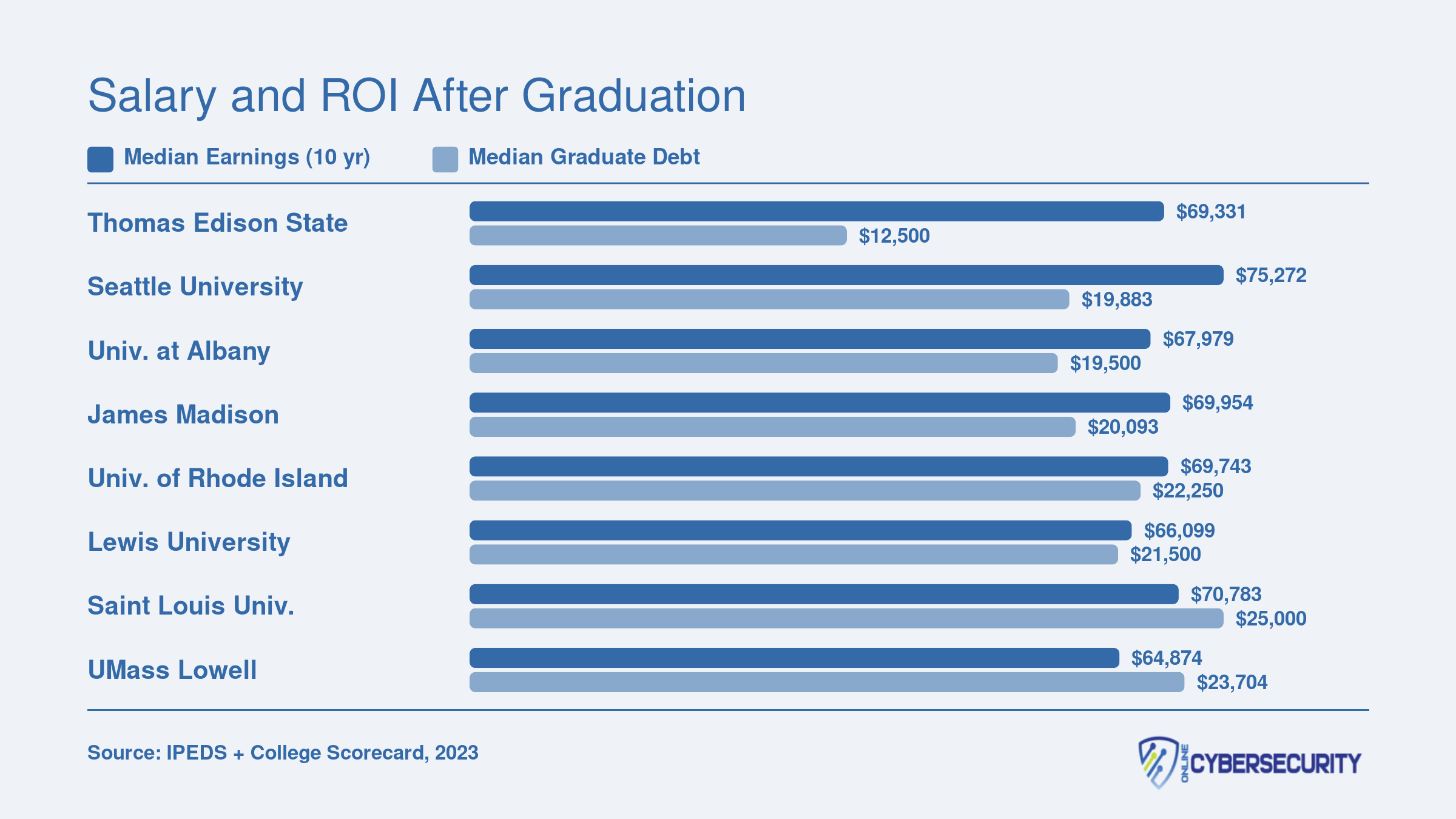
How do these top online cybersecurity master's programs stack up on long-term return? We compared each school's institution-level median earnings at ten years after enrollment against its median graduate debt to calculate an ROI ratio. For context, the BLS reports a median annual wage of $124,910 for information security analysts, with the field projected to grow 29% through 2034, roughly 16,000 openings per year. The strongest ROI belongs to Thomas Edison State University, where low debt ($12,500) and solid earnings combine for a ratio of roughly 5.5 to 1.
Cae-Designated Programs and Accreditation Guide
If you have spent any time researching cybersecurity graduate programs, you have probably seen the acronym "CAE" next to certain school names. That label is not marketing fluff. It is a nationally recognized designation awarded jointly by the National Security Agency and the Cybersecurity and Infrastructure Security Agency, and understanding what it means can help you make a sharper enrollment decision.1
What CAE-CD and CAE-CO Actually Mean
The National Centers of Academic Excellence program currently issues two primary designations relevant to master's students:
- CAE-CD (Cyber Defense): Awarded to institutions whose curricula meet rigorous Knowledge Unit requirements in areas like network defense, operating system hardening, and risk management. This is the most common designation and signals that coursework aligns with the national cybersecurity workforce framework.
- CAE-CO (Cyber Operations): A more selective designation focused on offensive and deeply technical skills, including vulnerability analysis, reverse engineering, and exploitation. Fewer schools hold CAE-CO status because the technical bar is considerably higher.
Some institutions also carry the CAE-R (Research) designation, which signals active, faculty-led cybersecurity research. Schools with multiple designations tend to offer broader curriculum depth.
Which Ranked and Notable Programs Hold CAE Status
Several schools that appear across our ranked list and our broader "programs to consider" pool carry current CAE designations as of 2026:
- Mississippi State University (M.S. in Cyber Security and Operations) holds CAE-CD, CAE-CO, and CAE-R, making it one of only a handful of schools with all three.2
- New York University's M.S. in Cybersecurity carries both CAE-CD and CAE-CO.2
- Texas A&M University (M.Eng. in Cybersecurity) holds CAE-CD, CAE-R, and CAE-CO.3
- Dakota State University also carries CAE-CD, CAE-R, and CAE-CO.2
- University of Maryland Global Campus, Western Governors University, and the University of San Diego each hold CAE-CD designation.4
- Several schools on our main ranked list, including the University of Arizona and the University of Massachusetts Lowell, note their National Center of Academic Excellence status in their own program materials as well.
You can verify any school's current status through the official NCAE-C interactive map by filtering for CAE-CD or CAE-CO at the graduate level.
Regional Accreditation Is the Baseline
Every program in our rankings holds regional accreditation from a body such as the Higher Learning Commission, SACSCOC, or the Middle States Commission. That accreditation is essentially the entry ticket: it ensures credit transferability, financial aid eligibility, and a minimum institutional quality standard. If you want to explore how cybersecurity program accreditation factors into the broader degree experience, that context is worth reviewing. CAE designation sits on top of that baseline. Think of regional accreditation as the foundation of a house and CAE as a specialized inspection certifying that the electrical wiring meets a much higher code.
Why CAE Status Can Save You Money
Beyond curriculum credibility, attending a CAE-designated school can open doors to two major federal scholarship programs:
- CyberCorps Scholarship for Service (SFS): Funded through the National Science Foundation and administered by OPM, this program covers tuition, books, and a living stipend in exchange for a commitment to work in a government cybersecurity role after graduation.
- DoD Cyber Scholarship Program (CySP): The Department of Defense offers tuition, books, and a stipend to students at CAE institutions who agree to serve in DoD cybersecurity positions upon completing their degree.
Both programs are competitive, but you generally must be enrolled at a CAE-designated institution to be eligible. If cost is a significant factor in your decision, and it usually is, prioritizing a CAE school can dramatically reduce your out-of-pocket expense. For students focused on budget, our guide to affordable cybersecurity programs pairs well with this strategy. Mississippi State's total program cost of roughly $18,000 paired with a CySP award, for instance, could mean you graduate with zero tuition debt and a guaranteed job placement.
When evaluating any online cybersecurity master's program, check for both regional accreditation and CAE designation. The first protects your investment; the second tells employers and scholarship committees that your training meets a nationally validated standard.
According to the 2024 ISC2 Cybersecurity Workforce Study, the global cybersecurity workforce gap has reached roughly 4.8 million unfilled positions. That means employers worldwide are competing fiercely for qualified talent, making a master's degree one of the strongest ways to stand out and command higher starting offers.
Who Should Get an Online Cybersecurity Master's Degree?
Not every cybersecurity professional needs a master's degree, but for certain career trajectories and life situations, it can be the smartest move you make. Here is how to figure out whether you are a strong fit.
The Market Signals Are Clear
The cybersecurity workforce gap is projected to reach 4.8 million unfilled positions globally in 20261, and roughly 59 percent of cybersecurity teams report being understaffed.2 In the U.S. alone, more than 514,000 cybersecurity job postings were active in 2025, with a domestic workforce gap of about 265,000.3 That sustained demand means employers are actively competing for qualified talent, especially at mid and senior levels where a master's degree distinguishes candidates. About 15 percent of senior cybersecurity roles explicitly require a master's degree, and that share tends to climb for leadership, architecture, and research positions.3
You can check the Bureau of Labor Statistics (BLS.gov) for the latest cybersecurity job outlook and employer hiring trends. While BLS data does not break down online versus on-campus credentials, it gives you solid context for how fast the field is growing and which sectors are hiring hardest.
Profiles That Benefit Most
- Career changers with adjacent experience: If you have a background in IT, networking, software development, or even risk management, a master's program can bridge you into cybersecurity without starting from scratch. Many programs accept students whose undergraduate degree is in a different field.
- Working professionals aiming for leadership: Security managers, CISO-track professionals, and those targeting policy or compliance roles often find that a master's degree opens doors that certifications alone cannot.
- Military and government professionals: Federal roles, especially those tied to intelligence or defense, frequently prefer or require graduate-level education. CAE-designated online programs align well with these career paths.
- Professionals seeking specialization in emerging areas: Skills in AI/ML security and cloud security are among the most in-demand competencies in 2026. A focused master's program lets you build depth in these areas through structured coursework and capstone projects.
If you are considering the security architect career path, for example, a master's degree with an enterprise architecture focus gives you a significant edge in the hiring process. Similarly, professionals drawn to compliance leadership can explore how to become a compliance analyst and layer a graduate credential on top for faster advancement.
Do Your Own Homework First
Before committing tuition dollars, take a few practical steps to validate your decision.
- Review annual salary and hiring surveys from organizations like ISC2, ISACA, or SHRM. Their reports often include data on preferred credentials and hiring practices, though online-specific breakdowns may require some digging.
- Contact admissions or career services at programs you are considering and ask directly for employer feedback or placement statistics. Reputable programs will share this data openly.
- Search professional cybersecurity forums, such as the r/cybersecurity community on Reddit, the ISC2 Community, or LinkedIn groups focused on information security. Firsthand perspectives from hiring managers can reveal how online degrees are perceived in the roles you are targeting.
When a Master's May Not Be the Right Move
About 73 percent of entry-level cybersecurity job listings require a four-year degree, and 20 to 30 percent of cybersecurity postings accept equivalent experience in lieu of formal credentials.3 If you are brand new to IT and do not yet have foundational skills, a bachelor's degree or industry certifications may be a more efficient starting point. Browsing accredited cybersecurity programs online can help you compare undergraduate and graduate options side by side. A master's degree pays off best when it builds on real-world experience and moves you toward a specific career goal, not when it substitutes for hands-on fundamentals.
The bottom line: an online cybersecurity master's degree is worth pursuing when the program is credible, properly accredited, and relevant to where you want your career to go.4 If those boxes check out, the market is very much on your side.
Admissions Requirements and What Programs Really Look For
If you are researching top online cybersecurity master's programs, you will notice that admissions criteria follow a fairly predictable pattern, but the details matter more than most applicants realize. Here is what to expect and how to position yourself for a strong application in 2026.
GPA Floors and Transcript Expectations
Most programs set a minimum undergraduate GPA of 3.0 on a 4.0 scale. Georgia Tech's Online Master of Science in Cybersecurity, Harvard Extension's ALM in Cybersecurity, and George Washington University's online MS all use that 3.0 benchmark.234 A handful of schools offer conditional admission for applicants who fall just below the cutoff. Houston Christian University, for example, considers applicants with GPAs between 2.5 and 2.99 on a case-by-case basis, sometimes requiring additional coursework or evidence of professional growth before full matriculation.5
GRE and GMAT Policies
The trend across online cybersecurity master's programs has moved decisively toward test-optional admissions. Georgia Tech, Harvard Extension, and George Washington University all offer GRE waivers in their current admissions cycles.234 Some programs have dropped the requirement entirely. If you have been away from academia for a while, this is welcome news: strong professional credentials or work history can speak louder than a standardized test score.
What Career Changers Need to Know
You do not need a computer science degree to get in, though programs do want evidence you can handle graduate-level technical material. Houston Christian University accepts applicants who hold at least 18 credits in computer science or information systems, or who carry industry certifications such as CISSP, Security+, or CEH paired with at least two years of relevant work experience.5 Harvard Extension uses a performance-based model where you essentially earn your way into the program by completing designated courses (CSCI 159 and CSCI 155) with strong grades before formally enrolling.3
These alternative pathways make a real difference for professionals transitioning from fields like network administration, compliance, military intelligence, or IT support. If you are mapping out a broader cybersecurity career path, understanding these entry points is an important first step.
Bridge and Prerequisite Courses
This is a practical detail worth highlighting because many competitors skip it entirely. Several programs now offer bridge or prerequisite courses designed specifically for students without a technical undergraduate degree. Rather than rejecting non-CS applicants outright, these programs let you fill knowledge gaps in areas like programming fundamentals, networking, or operating systems before you begin core cybersecurity coursework. If a program lists prerequisite expectations on its admissions page, look closely: it often signals that they welcome a diverse applicant pool and have a clear on-ramp for career changers.
The bottom line is that admissions committees are evaluating your readiness, not just your transcript. A combination of relevant certifications, professional experience, and a willingness to complete foundational coursework can make your application competitive even if your bachelor's degree is in an unrelated field.
How to Choose the Right Online Cybersecurity Master's Program
Choosing the right program starts with an honest look at where you want your career to land. Online cybersecurity master's degrees generally cluster around three track types, and the differences in coursework, career outcomes, and certification alignment are significant enough to shape your trajectory for years.
Three Track Types, Side by Side
Understanding what each track actually prepares you for is the fastest way to narrow your search.
- Technical Track: Core courses center on penetration testing, digital forensics, secure coding, and network defense. This track targets hands-on roles such as security engineer, red team operator, or forensics analyst. It aligns well with certifications like OSCP, GIAC, and CEH.1 If you come from a background in software development, systems administration, or IT engineering, this is likely your natural fit.
- Management Track: Coursework focuses on risk management, security governance, executive communication, and compliance frameworks. The target career path leads to roles like security manager, director of information security, or chief information security officer. Certifications such as CISSP, CISM, and CRISC map directly to this curriculum.1 Professionals with mid-career IT experience or business leadership backgrounds tend to thrive here.
- Interdisciplinary/Policy Track: Expect courses in cyber policy, cyber law, intelligence analysis, and public-sector security strategy. Graduates often move into policy analyst, cyber threat intelligence analyst, or government advisory roles. Relevant certifications include CIPP, GCTI, and CISSP.1 Candidates with backgrounds in political science, law, military service, or public administration will find this track especially relevant.
Format and Timeline Considerations
Most programs require 30 to 36 credits, but how you complete them varies widely.2
- Delivery format: Some programs are fully asynchronous, letting you complete coursework on your own schedule from anywhere. Others use a hybrid model that includes short residencies or synchronous lab sessions, which can be especially valuable in the technical track where hands-on lab work matters.
- Full-time pace: Expect to finish in roughly 12 to 24 months.2 This works well for students who can dedicate themselves to study without juggling a full-time job.
- Part-time pace: Most working professionals land in the 24 to 36 month range.3 If you plan to keep your current position while studying, confirm that the program offers evening or weekend options and that course sequencing does not bottleneck your progress.
Matching the Track to Your Goals
Before committing, ask one clarifying question: do you want to build systems, lead teams, or shape policy? Your answer points directly to one of the three tracks above. Programs at institutions like Duke, the University of Arizona, and WGU each lean into different strengths across these categories, so reviewing their specific concentrations and elective options will help you confirm the fit.
If you are still uncertain, look at job postings for the role you want in two to three years. Note which skills and certifications appear most often, then trace those back to the track that covers them. That reverse-engineering approach removes much of the guesswork and keeps your investment aligned with real employer demand.
Cybersecurity Master's FAQ
Below are answers to the questions we hear most often from career changers and working professionals evaluating an online cybersecurity master's degree. Where possible, we've referenced data and sections covered earlier in this article.
What is the best online master's in cybersecurity?
How much does an online cybersecurity master's cost?
Is a master's in cybersecurity worth it?
How long does it take to complete an online cybersecurity master's?
What can you do with a master's degree in cybersecurity?
Which online cybersecurity programs have CAE designation?
Do online cybersecurity master's programs require the GRE?
More Online Cybersecurity Master's Programs to Consider
Below, you'll find additional online cybersecurity master's programs that complement our top-10 ranking. These schools offer strong options for students whose priorities may differ, whether you're looking for a specific concentration, a more affordable tuition, or a particular learning format.
- Master of Business Administration with a Concentration in Cybersecurity Management
- Cybersecurity, M.S.
- Master of Science in Cybersecurity
- Master of Science in Cybersecurity Analytics and Operations
- Master of Professional Studies in Cybersecurity Analytics and Operations
- Master of Science in Cyber Engineering
- Master of Science in Cybersecurity and Risk Management
- Master of Science in Cyber Operations and Resilience
- Professional Science Master’s Degree in Cyber Security
- MBA in Cybersecurity Management
- Master of Computer Science – Cybersecurity
- Master of Science in Cybersecurity
- Master of Science in Information Security
- Master of Science in Cybersecurity (Cyber Security Analyst)
- Master of Science in Cybersecurity (Ethical Hacking)
- Master of Science in Cybersecurity (Computer Forensics)
- Master of Science in Cybersecurity
- Master of Science in Cybersecurity (Digital Forensics)
- Master of Science in Cybersecurity (Cybersecurity Operations)
Explore Programs
Related Programs
- Best Affordable Online Cybersecurity Degrees
- Best Bachelor's in Computer Science Cybersecurity
- Best Fastest Online Cybersecurity Degrees in
- Best Online Associate Degrees in Cybersecurity
- Best Online Bachelor's in Cybersecurity
- Best Online Cybersecurity Bootcamps in
- Best Online Cybersecurity Law Degrees for
- Best Online Graduate Certificates in Cybersecurity
- Best Online Ph.D. in Cybersecurity Programs for