
What you’ll learn in this article…
- Illinois has over 19,000 unfilled cybersecurity positions, giving online graduates strong job market leverage heading into 2026.
- Public university tuition starts below $10,000 annually, while private options can approach $69,000 per year.
- NSA CAE-designated programs in Illinois meet rigorous federal curriculum standards and unlock exclusive scholarship opportunities.
- Chicago area information security analysts earn roughly $3,000 more per year than the statewide average.
Illinois currently has more than 19,000 unfilled cybersecurity positions, driven largely by the concentration of Fortune 500 headquarters, major financial institutions, and federal agencies anchored in and around Chicago. For career changers eyeing this gap, the practical challenge is sorting through a fragmented market of online programs that vary widely in cost, credential level, and employer recognition. In-state tuition for an online master's can run under $12,000 at a public university or exceed $39,000 at a private one, and ROI differences are just as stark.
The seven programs ranked on this page span bachelor's through graduate certificate levels, scored by a composite that weighs graduation outcomes, net price, and student support alongside program fit. Illinois employers increasingly treat CAE designation and hands-on lab components as baseline expectations, not extras. If you are still exploring how to become a cybersecurity professional, this guide will help you understand which Illinois programs align with your career stage and goals.
2026 Best Online Cybersecurity Programs in Illinois: Rankings
These rankings reflect a composite quality score that blends institutional strength, program relevance, and online delivery suitability. Rather than relying on a single metric, each school was evaluated across multiple dimensions, including graduation outcomes, affordability after aid, student support ratios, and the depth of its cybersecurity curriculum, so the final order rewards well-rounded programs that serve online learners effectively.
- Online delivery and flexibility
- Institutional graduation outcomes
- Affordability after financial aid
- Student-to-faculty support ratio
- Program depth and curriculum quality
- Internal program database
- College Scorecard graduate earnings — collegescorecard.ed.gov
- Independent program research
- NCES-IPEDS federal institutional data — nces.ed.gov
- #1
Lewis University
Romeoville, IL · $17,000/yr
Best for: Working professionals near Chicago
Lewis University, located in Romeoville with strong ties to the Chicagoland tech corridor, offers a STEM-designated Master of Science in Cybersecurity built for working professionals. The program uses an industry-driven curriculum with hands-on projects, small class sizes, and close faculty mentorship. With evening and online course options, plus access to internship pipelines in Chicago's financial, logistics, and healthcare sectors, Lewis combines flexibility with real-world career preparation. The institution reports a 13:1 student-to-faculty ratio and an average net price of approximately $17,028 after aid.
View program
- STEM-designated graduate program with extended OPT eligibility
- Industry-driven curriculum with hands-on projects
- Available online and through evening hybrid formats
- Foundation coursework available for career changers without CS backgrounds
- Small class sizes with individualized faculty mentorship
- Access to Chicagoland employer networks in finance, healthcare, and logistics
- Admissions require bachelor's degree, transcripts, and statement of purpose
- Program ranges from 33 to 45 credits depending on background
- #2
Eastern Illinois University
Charleston, IL · $14,000 – $16,000/yr
Best for: Budget-minded career changers seeking certifications
Eastern Illinois University offers both a Master of Science in Cybersecurity and a stackable Graduate Cybersecurity Certificate, both designed with working Illinois professionals in mind. The 32-credit-hour master's program delivers most coursework online, supplemented by two brief on-campus residencies for intensive lab work and capstone experiences. Its curriculum explicitly prepares students for CISSP and CompTIA Security+ certifications. With an average net price of roughly $12,786, EIU is among the most affordable options on this list, and its 14:1 student-to-faculty ratio supports accessible instructor interaction. Note that the institution-wide graduation rate is 47.4%, which reflects the broader university and not this specific program.
View 2 programs
- 32 semester hours with majority of coursework delivered online
- Two brief on-campus residencies for hands-on labs and capstone
- Designed to prepare graduates for CISSP and Security+ exams
- No thesis required; culminates in team-based security exercises
- Faculty hold active industry certifications and conduct research
- Hybrid format built around working professionals' schedules
- 18 credit hours: 12 core plus 6 elective hours
- Stackable credential that feeds directly into the full M.S. program
- Electives include Cryptography, Biometrics Security, and Networking
- Current EIU graduate students can add via Change of Status form
- Minimum 2.75 GPA required for admission
- Ideal for Illinois IT professionals seeking a formal credential
- #3
University of Chicago
Chicago, IL · ~$15,000/yr (est.)
Best for: Experienced security professionals adding ML skills
The University of Chicago brings its research-driven reputation to cybersecurity through a five-week online Machine Learning for Cybersecurity certificate. This non-degree professional education course is aimed at information security managers, DevOps engineers, and developers who want to apply supervised and unsupervised learning techniques to threat detection and adversarial defense. The program features live online sessions, self-paced coursework, and a capstone case study with direct faculty feedback. At the institutional level, UChicago boasts a 95.9% graduation rate and a 5:1 student-to-faculty ratio, though this short course functions differently from a traditional degree program.
View program
- Five-week online course awarding 2.4 CEUs
- Open enrollment with no prior machine learning experience required
- Covers adversarial ML, intrusion detection, and anomaly detection
- Includes ethics and fairness in AI-driven cybersecurity
- Live online classes combined with self-paced pre-recorded lectures
- Capstone case study applying ML models to real cybersecurity datasets
- Requires basic programming (Python), probability, and linear algebra
- Designed for security managers, sysadmins, and DevOps engineers
- #4
University of Illinois Springfield
Springfield, IL · ~$10,000/yr (est.)
University of Illinois Springfield stands out for offering multiple online cybersecurity pathways through its AACSB-accredited College of Business and Management. Students can pursue a fully online M.S. in Cybersecurity Management, an MBA with a Cybersecurity Management concentration, or an MBA with a Cybersecurity Administration certificate. All programs cost approximately $16,500 in total tuition, require 30 credit hours, and can be completed in as few as 12 months through eight-week course terms. UIS holds a National Center of Academic Excellence in Cyber Defense designation, and its average net price after aid sits at about $9,833, making it the most affordable institution on this list. The institution-wide graduation rate is 53.2%.
View 3 programs
- 30 credit hours completable in as few as 12 months
- 100% online with eight-week course terms
- Total program tuition of approximately $16,500
- Covers digital forensics, compliance, and risk management
- No GMAT required for admission
- Hands-on, real-world project-based instruction
- 30 credit hours at $550 per credit hour online
- AACSB-accredited business school curriculum
- NCAE-C designated program
- Combines core MBA coursework with cybersecurity electives
- Gateway courses available for non-business undergraduate majors
- Multiple start dates throughout the year
- Same 30-credit, $16,550 structure as companion MBA options
- Focuses on defending against cyberattacks and managing data risks
- Teaches enhanced security policies and contingency planning
- Same faculty who teach on-campus sections
- Fully online format designed for working professionals
- NCAE-C recognized program
- #5
Aurora University
Aurora, IL · $19,000/yr (net price)
Aurora University offers a Bachelor of Science in Cybersecurity with two distinct tracks: Technical Analyst and Policy and Management. The undergraduate program requires 120 semester hours and emphasizes current technologies, teamwork, and ethical awareness alongside core programming coursework. While delivered primarily in a traditional or hybrid format, the program's dual-track design gives students flexibility to tailor their education toward hands-on infrastructure defense or organizational security leadership. Aurora's average net price after aid is approximately $18,838, with an institution-wide graduation rate of 60.3%.
View program
- 120 semester hours with 56 credits dedicated to the major
- Technical Analyst track for infrastructure and security implementation
- Policy and Management track for organizational cybersecurity leadership
- Core coursework in programming and technical security skills
- Emphasizes teamwork, ethical awareness, and current technologies
- No grades lower than C accepted in major coursework
- 30-hour residency and 30-hour upper-division requirements
- #6
McKendree University
Lebanon, IL · $25,000/yr (net price)
McKendree University's fully online MBA in Cyber Defense combines graduate business education with cybersecurity specialization in a 36-credit program. Aligned with NIST knowledge requirements, the curriculum covers cyber threat assessment and defense management, preparing graduates for roles such as Information Security Officer. Full-time students can finish in as little as 12 months. Faculty bring real-world experience and offer individualized attention in a flexible online format. McKendree's average net price after aid is approximately $24,717, and its institution-wide graduation rate is 53.3%.
View program
- 36 total credits, completable in as little as 12 months
- Fully online delivery with flexible scheduling
- Curriculum aligned with NIST cybersecurity knowledge requirements
- Prepares students for Information Security Officer roles
- Faculty with real-world cybersecurity and business experience
- Foundation courses available for students without business prerequisites
- Individualized professor attention in an online setting
- #7
DeVry University-Illinois
Lisle, IL · $31,000/yr (net price)
DeVry University's Illinois campus offers multiple online bachelor's programs in cybersecurity, including a B.S. in Cybersecurity and Networking, a B.S. in Computer Information Systems with a Cyber Security Programming specialization, and a B.S. in IT and Networking with a Cyber Security specialization. All programs use a 3-in-1 stackable design, awarding an undergraduate certificate and associate degree on the way to the bachelor's, which helps students enter the workforce sooner. DeVry's virtual Cyber Skills Training Platform simulates real-world attacks, and coursework aligns with certifications like CompTIA Security+, CySA+, and Cisco CCNA. The institution-wide graduation rate is 36.6%, and the average net price after aid is approximately $30,770.
View 3 programs
- 124 credit hours across 8 semesters with accelerated option
- Stackable design: earn certificate and associate degree en route
- AI-integrated coursework with virtual sandbox lab environment
- Aligns with CompTIA Security+, CySA+, and Cisco CCNA certifications
- Certification exam reimbursement up to $300
- Classes start every 8 weeks with transfer up to 80 credits
- Future Cyber Defenders Scholars Program for mentoring
- ABET accredited with CAE-CD designation from NSA
- Prepares for CISA, CompTIA CySA+, and CEH certifications
- Courses in Python, C#, and Java for security applications
- Hands-on sandbox virtual learning platform
- Embedded certificate and associate degree credentials
- AI-supported security skills training included
- ABET accredited with CAE-CD designation
- Prepares for CompTIA PenTest+ and CCSP certifications
- Full-time and part-time options with 24/7 course access
- Stackable credentials: certificate, associate, and bachelor's
- Faculty with direct industry experience
- Classes begin every 8 weeks year-round
How We Ranked Illinois Online Cybersecurity Schools
Transparency matters when you are weighing options that could shape the next decade of your career. Many ranking lists leave you guessing about how schools were selected or scored. Our approach is different: every step is documented, and every metric is grounded in publicly available data.
Starting with Online Delivery
Before any scoring begins, we filter for programs that can genuinely be completed online. If a program requires you to be on campus for the majority of coursework, it does not make the list. This filter ensures that every school you see here is a realistic option whether you live in Chicago, downstate, or outside Illinois entirely. Our methodology mirrors the same standards we use when evaluating best online cybersecurity programs nationally.
Building the Quality Composite
Once online eligibility is confirmed, each institution is evaluated using a weighted composite that blends several dimensions:
- Net price after aid: This reflects an institution-wide average of what students actually pay once grants and scholarships are applied. It is not a guaranteed quote for any individual, but it provides a useful apples-to-apples cost comparison across schools.
- Graduation rate: Also measured at the institution level, this signals how effectively a school supports students through to completion. A high graduation rate suggests strong advising, manageable course loads, and adequate student services.
- Program-level outcomes: Where federal data includes median earnings, typical debt at graduation, and employment rates for specific cybersecurity programs, we fold those signals into the composite to gauge return on investment. Not every program reports this information yet, so we note when data is unavailable rather than guessing.
Why This Matters for You
One of the most common frustrations we hear from career changers is that ranking sites either hide their criteria or rely on reputation surveys with no connection to student outcomes. By grounding our methodology in verifiable, public metrics, and by being upfront about what each number does and does not represent, we aim to give you a decision-making tool you can actually trust.
If a metric is institution-wide rather than program-specific, we say so. If outcome data has not been published for a particular program, we tell you that plainly. You deserve that clarity, especially when tuition dollars and career momentum are on the line.
What Does an Online Cybersecurity Degree in Illinois Actually Cost?
Annual tuition for Illinois online cybersecurity programs spans a wide range, from under $10,000 at public universities to nearly $69,000 at elite private institutions. Public schools like Eastern Illinois University and the University of Illinois Springfield offer in-state rates below $12,000, while private options such as Aurora University and the University of Chicago sit considerably higher. Keep in mind that the institution-wide average net price after financial aid can shrink these sticker prices dramatically: for example, the University of Chicago's net price drops to roughly $14,860 after aid.
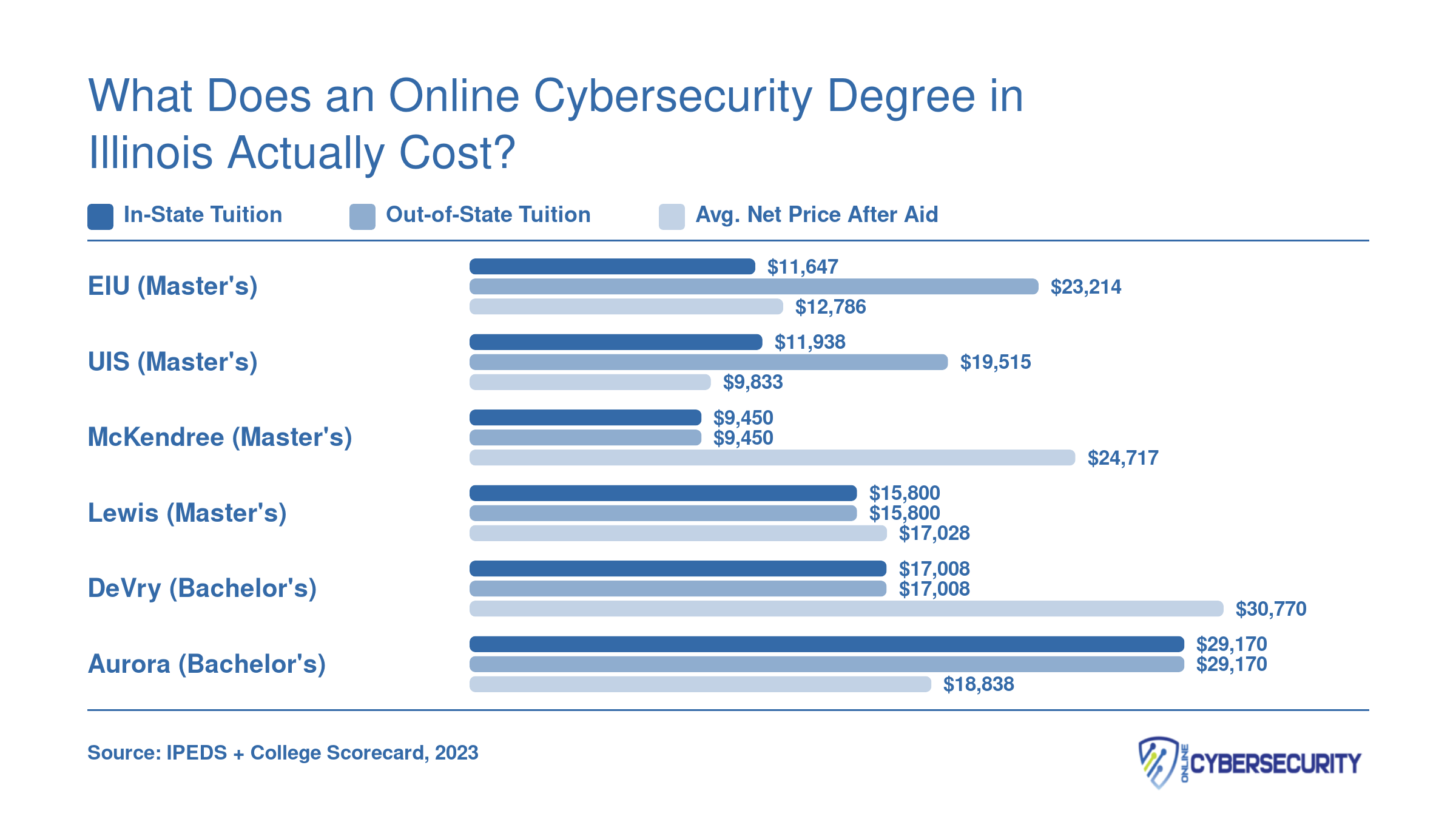
Program Cost and ROI Comparison for Illinois Cybersecurity Graduates
The table below compares estimated net price, median graduate debt, median earnings ten years after enrollment, and an approximate return on investment (ROI) ratio for seven Illinois schools offering online or hybrid cybersecurity programs. A few important caveats: net price figures are institution-wide averages (not specific to the cybersecurity program), and median earnings reflect all graduates of each institution rather than cybersecurity completers alone. Program-level early earnings and program-level debt figures are not yet available for these schools, so the numbers here are best used as directional guideposts rather than guarantees. Per-credit tuition rates are also not included in this dataset; prospective students should visit each school's tuition page for exact per-credit costs. Among the top three by ROI ratio, the University of Chicago stands out with the strongest earnings relative to debt, followed by Lewis University and the University of Illinois Springfield, both of which pair moderate debt loads with solid ten-year earnings.
| School | Net Price (Est.) | Median Graduate Debt | Median Earnings (10 Yr) | ROI Ratio |
|---|---|---|---|---|
| University of Chicago | $14,860 | $15,000 | $91,885 | 6.13 |
| Lewis University | $17,028 | $21,500 | $66,099 | 3.07 |
| University of Illinois Springfield | $9,833 | $19,128 | $57,103 | 2.99 |
| Aurora University | $18,838 | $20,318 | $58,709 | 2.89 |
| McKendree University | $24,717 | $23,250 | $58,572 | 2.52 |
| Eastern Illinois University | $12,786 | $21,500 | $51,989 | 2.42 |
| DeVry University, Illinois | $30,770 | $24,807 | $45,987 | 1.85 |
Questions to Ask Yourself
CAE-Designated Online Cybersecurity Programs in Illinois
If you see the acronym "CAE" on a school's cybersecurity page, it signals something meaningful: the National Security Agency has reviewed that institution's curriculum and confirmed it meets rigorous academic standards. Understanding these designations can save you time, open scholarship doors, and give your resume an extra edge with employers who know what the label represents.
What the CAE Designations Mean
The NSA administers three tiers of Centers of Academic Excellence designation:
- CAE-CD (Cyber Defense): The most common designation. It validates that a school's curriculum covers a defined body of knowledge in defensive cybersecurity, from network security and operating systems hardening to risk management.
- CAE-R (Research): Reserved for doctoral and research-intensive institutions producing original cybersecurity scholarship. Only one Illinois school currently holds this designation.
- CAE-CO (Cyber Operations): Focused on offensive and technical operations, this is the rarest designation. As of 2026, no Illinois institution holds CAE-CO status.1
Why does this matter to you? CAE-designated schools are eligible for federal scholarship programs like CyberCorps Scholarship for Service (SFS), which covers full tuition plus a living stipend in exchange for government service after graduation. Many federal agencies and defense contractors also treat a CAE-backed degree as a hiring preference.
Illinois Institutions with CAE Designation
Ten Illinois institutions currently hold CAE-CD status:2
- College of DuPage
- DePaul University
- Illinois Institute of Technology
- Illinois State University
- John A. Logan College
- Lewis University
- Lincoln Land Community College
- Moraine Valley Community College
- University of Illinois Springfield
- University of Illinois Urbana-Champaign (also holds CAE-R)3
Which CAE Schools Appear on Our Ranked List?
Of these ten, two appear in our 2026 ranked online cybersecurity programs for Illinois:
- Lewis University offers a hybrid Cybersecurity M.S. with online coursework and carries CAE-CD status, making its graduates eligible for federal scholarship pipelines.
- University of Illinois Springfield delivers a fully online M.S. in Cybersecurity Management and also holds CAE-CD recognition, pairing affordability with federal validation.
If you are comparing online cybersecurity master's programs more broadly, both of these degrees hold up well against national peers. Illinois Institute of Technology holds CAE-CD status and offers an online Bachelor of Information Technology and Management, though that program covers broader IT territory alongside its cybersecurity components.4
One Important Caveat
CAE designation is awarded at the institution level, not to a specific degree program. A university may hold CAE-CD status based on one set of courses while offering multiple cybersecurity-related programs, and not every program at that school necessarily maps to the validated curriculum. Before enrolling, confirm directly with the school that your specific program of interest aligns with the CAE-designated coursework. Admissions advisors can usually point you to the exact courses that satisfy NSA requirements. Taking this step ensures you actually benefit from the designation rather than simply attending a school that happens to hold it.
Online Cybersecurity Degrees by Level: Associate to Doctorate
Illinois offers online cybersecurity programs across the full spectrum of degree levels, but the options are not evenly distributed. Understanding what is available at each tier will help you zero in on the right fit for your career stage and goals.
Associate Degrees
Associate-level cybersecurity programs typically take about two years to complete and serve as an accessible entry point for career changers or anyone new to IT. Illinois community colleges do offer associate degrees and certificates in cybersecurity-related fields, and these tend to be among the most affordable pathways available, often costing a fraction of a four-year degree. However, fully online associate options specifically branded as "cybersecurity" can be limited compared to broader information technology programs. If you are budget-conscious, exploring community college catalogs is well worth the effort, and you can also compare affordable cybersecurity programs nationwide. Many associate programs at this level incorporate preparation for foundational industry certifications like CompTIA Security+, giving graduates a credential employers recognize right away.
Detailed time-to-completion benchmarks for specific Illinois associate programs are not widely published, so it is worth contacting admissions offices directly for the most current scheduling information.
Bachelor's Degrees
A bachelor's degree in cybersecurity is the sweet spot for learners who want a comprehensive foundation and stronger long-term earning potential. Standard completion time runs about four years, though some programs offer accelerated tracks. Among the Illinois programs in our rankings, Aurora University offers a Bachelor of Science in Cybersecurity with tracks in both technical analysis and policy management. DeVry University-Illinois provides an online Bachelor's in Cybersecurity and Networking that can be completed in as few as two years and eight months for transfer students, and its curriculum is aligned with multiple industry certifications, including certification exam reimbursement. At the bachelor's level, look for programs that embed prep for Security+, CySA+, or Certified Ethical Hacker (CEH) exams, as these credentials significantly boost your employability right out of school.
Master's Degrees
The master's tier is where Illinois truly shines for online cybersecurity education. Most master's programs take 18 to 24 months and are designed for working professionals seeking advancement into leadership, architecture, or analyst roles. Our rankings include several strong options:
- Eastern Illinois University: Offers a hybrid Master of Science in Cybersecurity that prepares students for both the CISSP and CompTIA Security+ certifications, a notable differentiator for career-focused learners.2
- Lewis University: Provides a STEM-designated Cybersecurity M.S. with hybrid delivery and access to the Chicago tech ecosystem.
- University of Illinois Springfield: Features a fully online M.S. in Cybersecurity Management completable in as few as 12 months, with total tuition around $16,500.
- McKendree University: Offers an online MBA in Cyber Defense built around NIST knowledge requirements, completable in 12 months.
CISSP and Security+ prep are commonly embedded at this level, while some programs also cover digital forensics, compliance, and risk management frameworks.
Graduate Certificates and Doctoral Programs
For professionals who already hold a graduate degree or want a focused skill upgrade, online graduate certificate in cybersecurity programs offer a faster path. The University of Chicago, for instance, offers an online certificate in Machine Learning for Cybersecurity that runs just five weeks and targets working security managers, DevOps engineers, and developers.
Doctoral programs in cybersecurity are less common in Illinois online offerings and tend to be geared toward those pursuing research roles, higher education positions, or senior executive leadership. If a doctorate is your goal, it helps to weigh the cybersecurity phd career paths carefully, and you may need to look at hybrid or national online programs to find the right match.
Certification Prep as a Deciding Factor
Across every degree level, one of the most meaningful differentiators is whether a program weaves in preparation for recognized industry certifications. Here is a quick reference:
- Associate level: CompTIA Security+ prep is most common.
- Bachelor's level: Security+, CySA+, and CEH alignment appear in several curricula.
- Master's level: CISSP, Security+, and NIST framework preparation are frequently embedded.
- Certificate level: Specialized topics like machine learning for security or advanced threat analysis.
When comparing programs, ask each school which certification objectives are mapped into the coursework. That alignment can save you months of independent study and hundreds of dollars in separate prep courses.
According to the CyberSeek Cybersecurity Supply and Demand Heat Map, Illinois has more than 19,000 unfilled cybersecurity positions. That gap between open roles and qualified professionals means graduates of online cybersecurity programs in the state are entering a job market with exceptional demand and strong negotiating power.
Career Outcomes and Job Placement for Illinois Cybersecurity Graduates
Illinois is one of the strongest states in the country for cybersecurity employment, thanks to a dense concentration of Fortune 500 headquarters, financial institutions, healthcare systems, and government agencies that all need qualified security professionals. Understanding what graduates actually earn, and how schools support the transition from classroom to career, can help you make a smarter investment in your education.
What Program-Level Earnings Data Tells Us
For many of the Illinois cybersecurity programs featured in our rankings, program-specific earnings and employment outcomes are not yet available through federal reporting channels. This is common for newer or smaller programs that have not graduated enough cohorts for the data to be published. That said, institution-wide median earnings ten years after enrollment offer a useful proxy. Among the schools we ranked, those figures range from roughly $46,000 at the lower end to over $91,000 at the top, reflecting wide differences in degree level, student population, and program maturity. Treat these as context rather than a precise forecast for cybersecurity graduates specifically, since security roles typically command salaries well above institution-wide averages.
How Illinois Salaries Compare to the National Picture
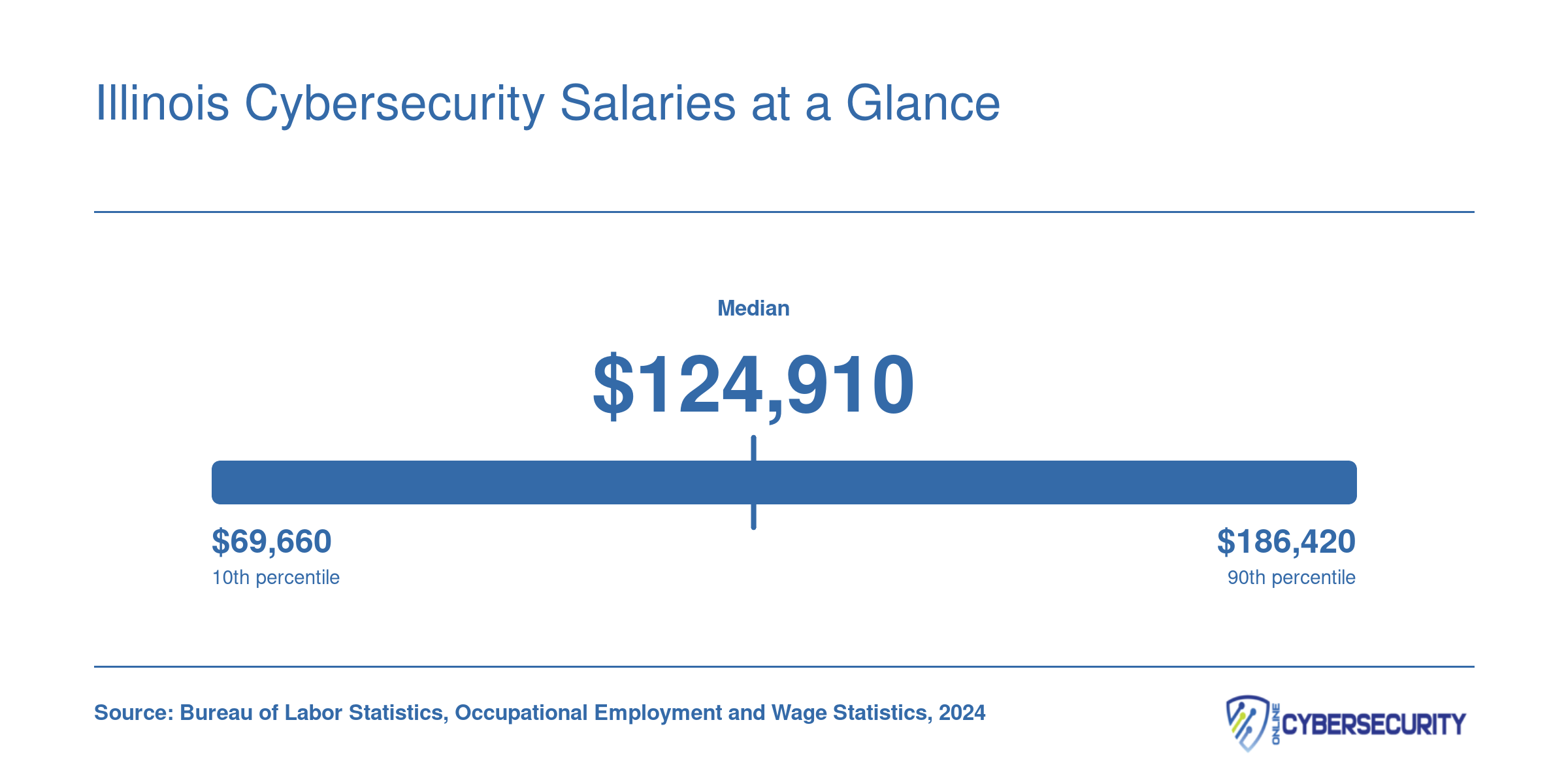
Nationally, information security analysts earned a median annual wage of about $124,910 as of the most recent Bureau of Labor Statistics data, with the bottom tenth percentile around $69,660 and the top tenth percentile reaching approximately $186,420.1 The Chicago-Naperville-Elgin metro area, which accounts for the majority of Illinois cybersecurity jobs, tends to track close to or slightly above these national figures due to the high demand from the financial services and technology sectors concentrated there. Even entry-level positions in the state generally start above the national median household income, making cybersecurity one of the more financially viable career pivots available. For a broader look at the roles you can target, our cybersecurity career guide breaks down specializations and typical responsibilities.
Job Placement Services and Employer Connections
Not every school publishes formal placement rates for cybersecurity graduates, but several Illinois programs actively promote career services and industry partnerships:
- Lewis University highlights its access to the Chicago tech ecosystem and offers close faculty mentorship, which often translates into networking opportunities with area employers.
- Eastern Illinois University promotes alumni networking events and prepares students for CISSP and CompTIA Security+ certifications, which are frequently required by hiring managers.
- University of Illinois Springfield designs its M.S. in Cybersecurity Management around working professionals, with hands-on projects and real-world scenarios that double as portfolio pieces.
- DeVry University-Illinois offers a certification exam reimbursement benefit and participates in a Future Cyber Defenders Scholars Program, signaling structured employer engagement.
When evaluating schools, ask admissions teams directly about employer partnerships, internship pipelines, and the percentage of recent graduates employed in the field within a year of finishing.
Illinois Workforce Demand and State Initiatives
Illinois has made cybersecurity workforce development a priority. The state government has invested in expanding technology apprenticeship programs, and several community college-to-university pathways now exist specifically for cybersecurity students. Chicago's status as a major financial hub means that banks, trading firms, and insurance companies are in constant competition for security talent, which keeps salaries elevated and job openings plentiful.2 Healthcare organizations across the state, bound by strict data protection regulations, add another layer of demand. For career changers, this means the labor market in Illinois is working in your favor: employers are often willing to hire candidates who hold a relevant degree and one or two industry certifications, even without years of prior security experience.
Illinois Cybersecurity Salaries at a Glance
Information security analysts in Illinois earn competitive wages, with the Chicago-Naperville-Elgin metro area pushing average salaries roughly $3,000 above the statewide mean. If you are targeting roles in the Chicago area, expect salaries to skew noticeably higher than positions downstate.
How to Choose the Right Illinois Online Cybersecurity Program
Picking the right online cybersecurity program is a big decision, especially if you are coming from another career, the military, or a workforce training background. The good news is that Illinois has a strong selection of programs built with non-traditional learners in mind. Here is a practical framework to help you narrow the field.
Evaluate Transfer and Prior Learning Policies
If you have college credits, military training, or professional experience, your first question should be how much of that work a program will recognize. Look for schools that accept credits from regionally accredited institutions and that offer prior learning assessment (PLA) options for workforce or military training. Some Illinois programs will evaluate Joint Services Transcripts or accept ACE-recommended credit for military coursework. Shaving even a semester off your timeline can save thousands of dollars and get you into the job market faster. If maximizing transfer credits is your top priority, explore options among the fastest cybersecurity degree with transfer credits available nationally. Ask the admissions office directly about maximum transfer limits and whether an accelerated track is available for students who enter with advanced standing.
Understand Tuition Structures for Online Students
Do not assume that attending an Illinois public university online means you will pay in-state tuition. Some schools charge a flat online rate regardless of where you live, which can be a significant advantage for out-of-state learners and a minor disadvantage for Illinois residents who might have paid less under a traditional in-state model. Others still differentiate by residency. Before comparing sticker prices, confirm:
- Flat-rate vs. residency-based tuition: Ask whether online students pay the same per-credit rate regardless of location.
- Mandatory fees: Technology fees, course material charges, and proctoring costs can add up quickly.
- Financial aid eligibility: Federal aid and Illinois-specific grants such as MAP awards may apply differently to online enrollments.
Look for Embedded Certification Prep
A program that aligns its coursework with industry certifications like CompTIA Security+ or ISC2 CISSP is telling you something important about its curriculum. Embedded certification prep signals that the faculty are tracking current industry expectations and that graduates will leave with skills employers actually test for. Some programs even bundle a voucher for the exam itself. This is a useful proxy for curriculum quality and a real accelerator for career readiness, particularly if you are making a career change and need to build credibility quickly.
Verify Accreditation and CAE Designation
Regional accreditation is the baseline. Without it, your degree may not transfer and some employers will not recognize it. Beyond that, check whether the program holds ABET accreditation for computing or engineering programs, which adds a layer of rigor. Also look for NSA/CISA Center of Academic Excellence (CAE) designation, which confirms that the curriculum meets national standards for cybersecurity education. Illinois has several CAE-designated institutions, and attending one can open doors to scholarships, federal hiring pipelines, and employer trust. If you are weighing graduate-level options, programs offering an online cybersecurity master's CAE designation can be especially valuable.
Ask About Job Placement Data
Finally, a program worth your investment should be willing to share placement outcomes. Ask for graduation rates, employment rates within six months or a year of completion, and whether the school partners with employers for internships or capstone projects. If a program cannot or will not share this information, treat that as a signal. Programs that report strong outcomes are usually proud to do so, and transparency here is a good indicator of how seriously the school takes your post-graduation success.
Taking thirty minutes to work through these five checkpoints before you apply can save you years of frustration and tens of thousands of dollars. The right program will meet you where you are and move you forward efficiently.
Frequently Asked Questions About Online Cybersecurity Degrees in Illinois
Choosing the right online cybersecurity program in Illinois can raise a lot of practical questions, from cost and timeline to certifications and career outcomes. Below are answers to the questions we hear most often from career changers and students exploring their options in 2026.