
What you’ll learn in this article…
- Washington information security analysts earn a median salary around $132,000, significantly above the national median.
- Several Washington online cybersecurity programs embed CompTIA Security+ and CySA+ preparation into their coursework.
- Net price after aid can differ dramatically from published tuition, especially at Washington public colleges.
- Degree options in Washington span certificates through bachelor's programs, fitting career changers at every stage.
Washington's information security analysts earn a median salary around $132,000, well above the national figure near $120,000. The state's concentration of major tech employers along the I-5 and I-405 corridors, combined with a significant federal defense footprint at Joint Base Lewis-McChord and nearby installations, keeps demand for cybersecurity talent persistently high. That demand makes Washington a strong place to study online, even if you never set foot on campus.
The ranked programs below span bachelor's and master's levels, with in-state tuition as low as roughly $4,400 per year at public colleges and per-credit costs reaching $760 at private institutions. Some hold NSA Center of Academic Excellence designations; others embed industry certifications like CompTIA Security+ directly into coursework. The gap between sticker price and actual net cost is often substantial, which makes comparing real expense and post-graduation earnings essential before committing. If you already hold transferable credits, a fastest competency based cybersecurity degree format could shorten your timeline significantly.
2026 Best Online Cybersecurity Schools in Washington: Rankings
The following ranking spotlights online-eligible cybersecurity programs across Washington State, ordered by a blended quality composite that weighs institutional outcomes, program depth, and return on investment rather than cost or time to completion alone. Whether you are a career changer eyeing an entry-level bachelor's or a seasoned professional ready for a leadership-focused master's, these programs reflect the strongest options available to Washington learners in 2026.
- Graduate earnings and debt outcomes
- Institutional graduation and retention rates
- Program depth and hands-on rigor
- Return on investment ratio
- Student support and faculty access
- College Scorecard graduate earnings — collegescorecard.ed.gov
- NCES-IPEDS federal institutional data — nces.ed.gov
- Internal program database
- Independent program research
- #1
Green River College
Auburn, WA · $14,000/yr
Best for: IT support workers upgrading credentials affordably
Green River College delivers a Bachelor of Applied Science in Cybersecurity and Networking through its Auburn campus, serving the Seattle-Tacoma tech corridor with hybrid, online, and in-person scheduling options. The 180-credit program is industry-advised and emphasizes hands-on labs in cloud networking, security operations, and network administration. With a net price of roughly $13,803 after aid and an 11:1 student-to-faculty ratio, it offers an affordable, stackable pathway for students already working in IT support who want to pivot into security roles. The institution-wide graduation rate sits at about 39%, so prospective students should plan to take advantage of advising resources early. Program-level earnings data is not yet available for this specific degree.
View program
- 180-credit BAS blending networking and security coursework
- Hybrid, online, and in-person delivery options available
- Hands-on labs covering cloud networking and current security tools
- Prepares graduates for security analyst and network admin roles
- Aligned with CompTIA Security+ and Network+ preparation
- Industry advisory committee keeps curriculum market-relevant
- Flexible scheduling designed for working adults in Western WA
- #2
Seattle University
Seattle, WA · $35,000/yr
Best for: Non-technical professionals pursuing security leadership
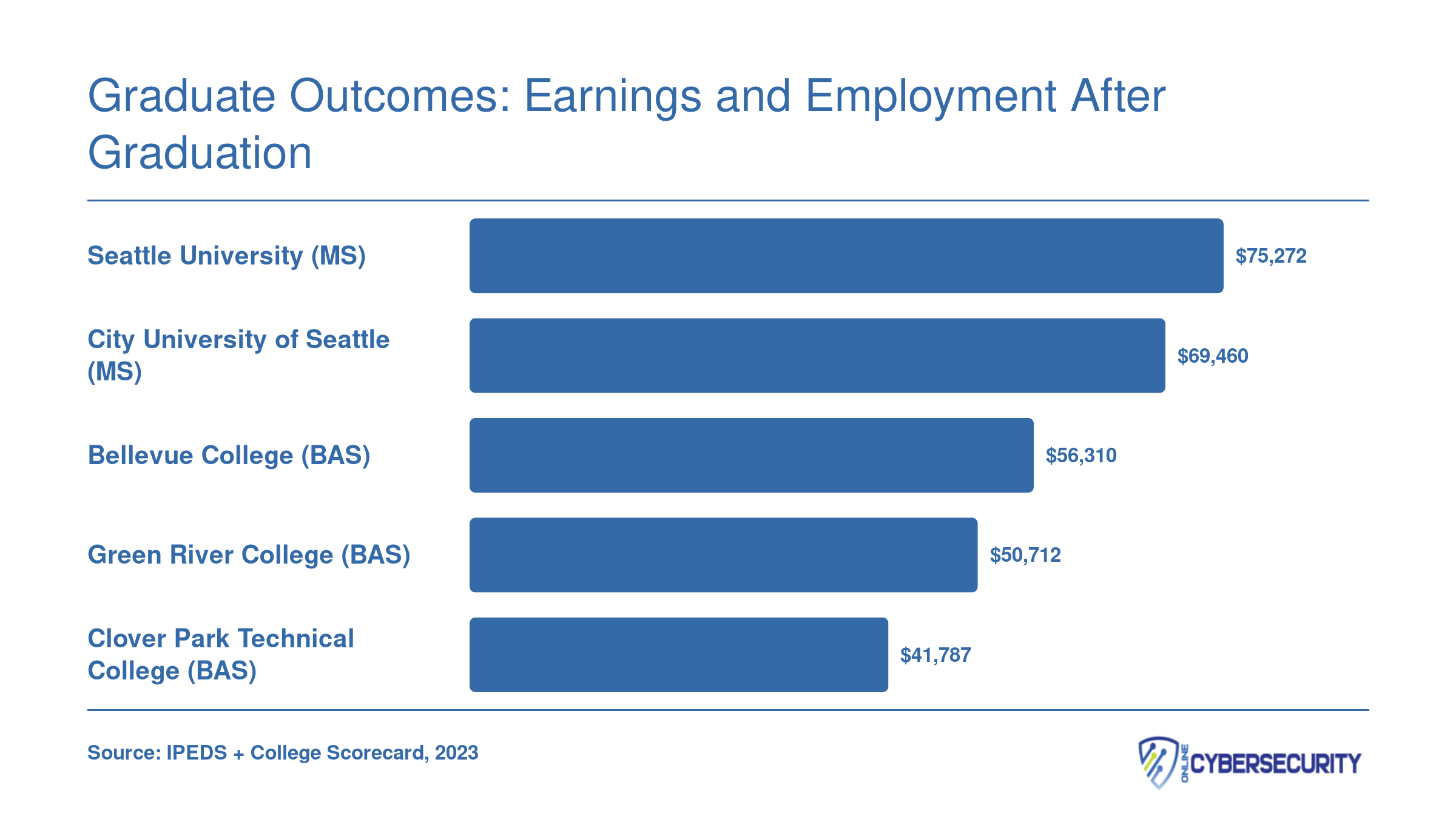
Seattle University's fully online Master of Science in Cybersecurity Leadership is built for professionals from any background, technical or otherwise, who want to step into governance, risk, and security leadership positions. Housed within the Albers School of Business and Economics, the 45-credit program can be completed in about two years with start dates in September and March. Coursework spans AI implications for cybersecurity, IT risk advisory, and law and ethics, taught by practitioner-faculty connected to the Pacific Northwest tech ecosystem. The institution-wide graduation rate is approximately 76%, and median earnings across all graduates reach about $75,272 ten years after enrollment. The net price after aid is around $34,662, and program-level earnings are not yet reported.
View program
- 45-credit fully online master's, completable in two years
- No specific technical background required for admission
- Curriculum covers AI governance, risk advisory, and cyber law
- Practitioner-faculty drawn from Seattle's security community
- September and March start dates fit employer tuition cycles
- Application fee waived; Grad PLUS loan benefits available
- Cross-sector focus spanning tech, healthcare, and government
- #3
City University of Seattle
Seattle, WA
Best for: Military-connected learners seeking CAE-designated programs
City University of Seattle holds a National Center of Academic Excellence in Cyber Defense (CAE-CD) designation, lending federal-level credibility to both its online Bachelor of Science and Master of Science in Cybersecurity programs. The fully online format serves working adults statewide, with particular appeal to military-connected students near Joint Base Lewis-McChord. The MS program runs 39 to 59 credits at $760 per credit and features a Cyber Defense emphasis, capstone project, and optional internship, while the BS grounds students in defensive operations, threat investigation, and ethical practices. With a 5:1 student-to-faculty ratio and practitioner-instructors embedded in the local security community, CityU emphasizes mentorship and networking. Program-level earnings are not yet published, though institution-wide median earnings reach about $69,460 at ten years.
View 2 programs
- 39 to 59 credits, fully online, $760 per credit
- Emphasis track in Cyber Defense with elective flexibility
- Capstone project and optional internship included
- CAE-CD designated, aligned with ACM Body of Knowledge
- Preparatory courses available for non-technical entrants
- Designed for working professionals across industries
- Fully online bachelor's focused on defensive cybersecurity
- Covers threat investigation, data misuse, and ethical practices
- Builds foundational computing and technical security skills
- Flexible scheduling built for working adults statewide
- Supports military training transfer and experience waivers
- Prepares graduates for information security career entry
- #4
Clover Park Technical College
Lakewood, WA · $10,000/yr (net price)
Clover Park Technical College's Bachelor of Applied Science in Cybersecurity takes a heavily hands-on approach, training students with current penetration testing, malware analysis, and cloud security tools in a hybrid format. Evening and weekend classes across its Lakewood, South Hill, and Eastside Training Center locations are designed for full-time workers in the South Puget Sound area. Full-time students can finish in about 18 months, while part-time learners typically need around 36 months. The net price after aid is approximately $9,864, making it one of the most affordable bachelor's-level cybersecurity options in the state. The institution-wide graduation rate is roughly 43%, and median graduate debt is about $12,112. Program-level earnings are not yet available.
View program
- Hybrid BAS completable in 18 months full-time or 36 part-time
- Evening and weekend classes across three campus locations
- Hands-on labs with current penetration testing and SIEM tools
- Curriculum covers risk assessment, malware, and cloud security
- Admission open every quarter for flexible entry points
- Net price after aid approximately $9,864
- Industry advisory board aligns coursework with regional demand
- #5
Bellevue College
Bellevue, WA · $11,000/yr (net price)
Bellevue College's Bachelor of Applied Science in Cybersecurity serves the Eastside tech hub, drawing students who are often already employed in IT roles at major cloud and enterprise companies in the Bellevue and Redmond corridor. The 180- to 182-credit hybrid program blends network security, digital forensics, security automation, and system hardening with a capstone or internship experience tied to local employers. Selective admissions require an associate degree in IT or a related field and a minimum 2.0 GPA. With a net price of about $11,430 after aid and in-state tuition around $4,436, it remains a cost-effective completion pathway for community college transfer students. The institution-wide graduation rate is approximately 36%, and program-level earnings data is not yet reported.
View program
- 180 to 182 credits blending theory and technical practice
- Hybrid delivery aimed at working adults on Seattle's Eastside
- Covers network security, digital forensics, and automation
- Capstone or internship connects students to local employers
- Selective admissions require an IT-related associate degree
- Strong transfer articulation with WA community colleges
- Regional advisory committee aligns skills with employer needs
- In-state tuition approximately $4,436 per year
How We Ranked Washington's Online Cybersecurity Schools
Choosing among Washington's online cybersecurity programs is easier when you know exactly what goes into the numbers. Here is a clear look at the criteria behind the rankings you see above, so you can weigh each school with confidence.
Online Delivery and Quality Baseline
Every program in our list first had to meet an online-delivery eligibility threshold, meaning the degree can be completed primarily or entirely online by Washington residents. From there, each school received a composite quality score built from several measurable indicators:
- Graduation rate: An institution-wide figure that reflects a school's overall student-success track record. Because program-specific graduation data is not broadly published, this metric serves as a practical proxy for how well the school supports learners through to completion.
- Net price: A sector-conditional average that approximates what students actually pay after grants and scholarships. Think of it as a ballpark rather than an exact quote, since individual aid packages vary.
- Scorecard earnings: Median earnings reported through College Scorecard, capturing what actual completers earn after leaving the program.
- Debt outcomes: How graduates' debt loads compare relative to their post-completion earnings, giving you a sense of return on investment.
Program-Level Earnings Data
Where available, we incorporate program-level earnings measured at one, two, and four years after completion. These figures come directly from College Scorecard and reflect real outcomes for people who finished cybersecurity or closely related programs, not projections or survey estimates. When a school's program-level earnings have not yet been published, we note that clearly in the ranking card rather than filling in approximations.
Transparency You Can Verify
Every data point that shapes a school's position in the list is visible in its ranked card above. You will find graduation rates, net price estimates, and earnings figures laid out side by side, so nothing is hidden behind a proprietary formula. If a particular metric is unavailable for a school, you will see that noted as well. The goal is to give career changers and students exploring cybersecurity education in Washington an honest, apples-to-apples comparison without having to dig through federal databases on your own.
Use these data points as a starting framework, then layer in your own priorities, whether that is schedule flexibility, embedded certification preparation, or proximity to Washington's major cybersecurity employers, to find the program that fits your career goals best. If you want to compare schools beyond state lines, our guide to the best online cybersecurity programs can help you broaden the search.
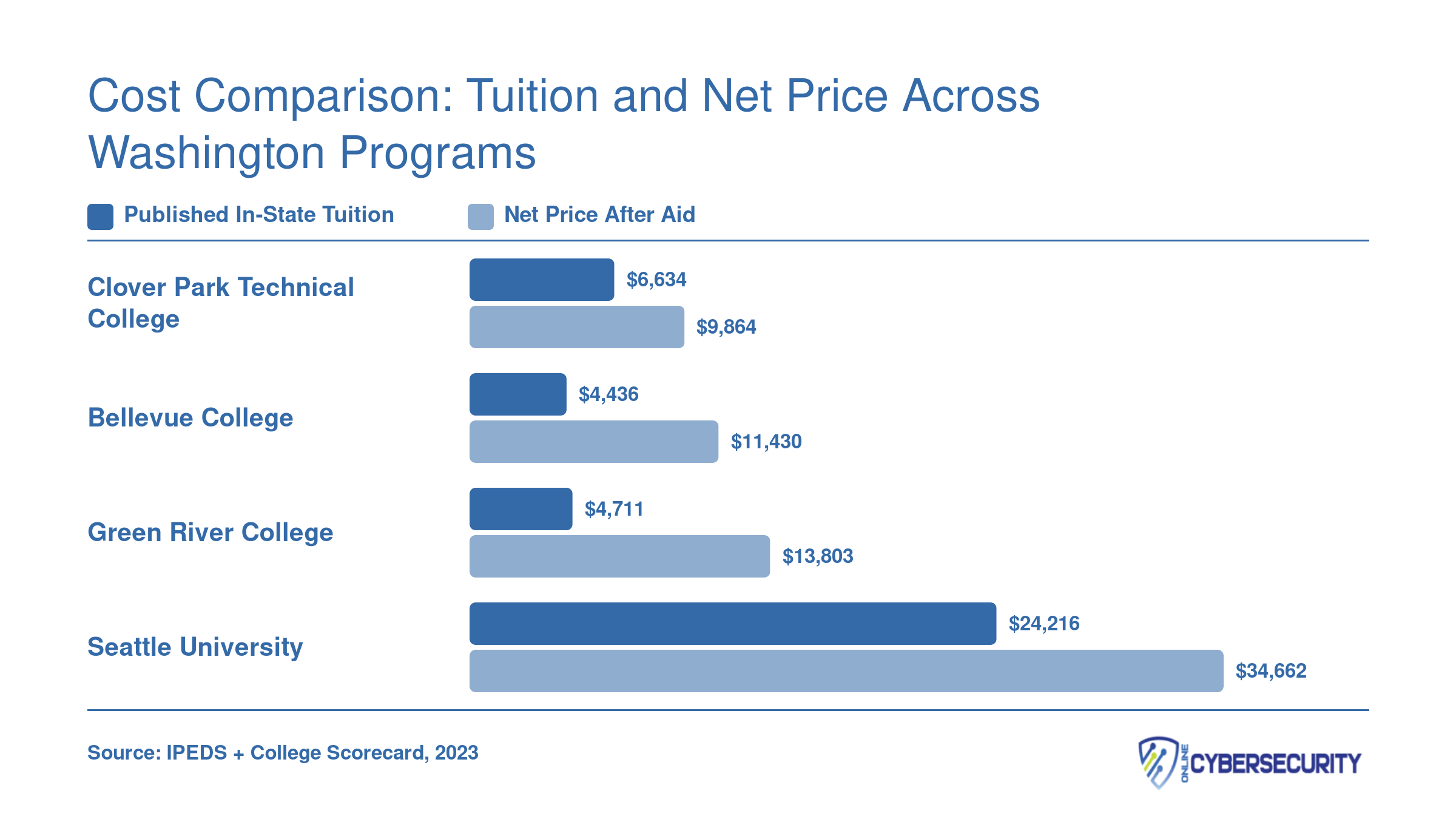
Cost Comparison: Tuition and Net Price Across Washington Programs
Sticker price rarely tells the full story. After factoring in grants, scholarships, and institutional aid, the net price most students actually pay can look very different from published tuition. The gap is especially visible when comparing Washington's public colleges to its private university option. Among the four ranked programs, annual net prices range from roughly $9,900 to nearly $34,700, so understanding total cost before you enroll is essential.
Related Articles
CAE-Designated Online Programs in Washington
If you are exploring online cybersecurity degrees in Washington, you have probably come across references to "CAE-designated" schools. Understanding what that label means, and what it does not mean, can help you make a smarter enrollment decision.
What the CAE Designations Actually Mean
The National Security Agency and the Department of Homeland Security jointly award Centers of Academic Excellence designations to colleges and universities that meet rigorous curriculum and faculty standards in cybersecurity.1 There are several designation types, each aimed at a different focus area:
- CAE-CD (Cyber Defense): Programs centered on defensive cybersecurity principles, network protection, and risk management.
- CAE-CO (Cyber Operations): A more selective designation focused on offensive and applied cyber operations, including penetration testing and vulnerability analysis.
- CAE-R (Cyber Research): Reserved for doctoral-level universities with significant research activity in cybersecurity.
- CAE-2Y (Two-Year): Covers associate-level programs at community and technical colleges.
Why does this matter to you? CAE-designated programs open doors to federal hiring pipelines and scholarship opportunities like the CyberCorps Scholarship for Service program, which covers tuition and provides a stipend in exchange for government service after graduation. Employers across the public and private sectors also recognize the designation as a signal of program quality.
Which Washington Schools Hold CAE Designations
As of 2026, two Washington institutions hold active CAE designations:
- Eastern Washington University (Cheney): Holds the CAE-CO designation, awarded in 2024 for a five-year period.2 Eastern Washington is currently the only CAE-CO designated institution in the state, which speaks to the selectivity of that credential.
- Washington State University (Pullman): Earned its CAE-R designation in 2025, also for a five-year cycle. WSU is one of only five CAE-R institutions in the Pacific Northwest, reflecting its doctoral-level research strength in cybersecurity.3
All CAE designations run on five-year renewal cycles, so it is worth confirming that a school's designation is current before you enroll.1 You can verify active designations through the CAE Institution Map maintained by the CAE Community.
A Critical Distinction: Institution vs. Online Program
Here is where many prospective students get tripped up. A school holding a CAE designation does not automatically mean every program at that institution, including online tracks, falls under the designation. The designation applies to a validated Program of Study, a specific set of courses and learning outcomes that have been reviewed and approved by the NSA.1
At Eastern Washington University, whether the CAE-CO designation covers an online format depends on whether that online track follows the same validated Program of Study. At Washington State University, the CAE-R designation is tied to its institutional research activity rather than a specific teaching program, so it operates differently from the curriculum-focused CAE-CD or CAE-CO labels. If you are weighing programs that pair cybersecurity with a broader computer science cybersecurity degree, understanding this distinction becomes even more important.
Before enrolling, contact the cybersecurity department directly and ask whether the online program you are considering is covered under the institution's CAE designation. Ask specifically about the validated Program of Study. This one question can save you from assuming benefits, like CyberCorps eligibility, that may not apply to your particular degree track.
Questions to Ask Yourself
Industry Certifications Built Into Washington Online Cybersecurity Degrees
One of the smartest moves you can make when choosing an online cybersecurity program is picking one that weaves industry certifications directly into your coursework. Earning a degree alongside credentials like CompTIA Security+ or CySA+ saves you time and money, and it signals to employers that you can hit the ground running. Here is a practical approach to finding and verifying which Washington programs deliver on that promise.
Start With School Program Pages
Visit each school's official cybersecurity degree or certificate page and look for a tab labeled "Curriculum," "Certifications," or "Program Details." This is where institutions typically list embedded exam vouchers or aligned certification paths. In Washington, several programs make this information easy to find:
- Washington Technical Institute: Its Cyber Security Certificate program aligns coursework with CompTIA Security+, CySA+, and PenTest+, covering a broad range of defensive and offensive skills.1
- Eastern Washington University: Offers Security+ certification training with an included exam voucher, so you can sit for the test as part of your tuition.2
- Central Washington University: Runs a cybersecurity bootcamp online that is aligned with CompTIA Security+ and includes an exam voucher.3
- Computing For All: Provides an accelerated 10-day CompTIA Security+ training track, with coursework also mapped to CySA+ and PenTest+ pathways.4
Some programs outside the state also serve Washington residents well. CSU Online, for instance, bundles a CompTIA Security+ exam voucher directly into its security certification course.5
Cross-Reference With National Standards
Before enrolling, check the U.S. Bureau of Labor Statistics at BLS.gov for its list of nationally recognized cybersecurity certifications. Compare those recommendations against what each school advertises. Programs at schools like WGU, City University of Seattle, and the University of Washington may align their curricula with certifications even if they do not explicitly bundle a voucher. The key is to distinguish between "aligned" (coursework covers exam objectives) and "embedded" (the program pays for or includes the exam itself).
Talk to an Advisor
Program descriptions sometimes lag behind what is currently offered. Contact admissions counselors or academic advisors directly and ask specific questions:
- Does the program include an exam voucher, or does it only prepare you for the exam?
- Which certification version does the coursework target (certifications update periodically)?
- Are there additional fees for certification attempts beyond the first?
Advisors can confirm whether credentials like CompTIA Security+, CySA+, or even CISSP preparation modules are part of the degree plan or available as elective add-ons.
Use Professional Association Resources
Organizations like CompTIA and (ISC)² publish detailed certification requirements, including prerequisite knowledge, exam objectives, and continuing education expectations. Pull up those requirements and compare them side by side with course syllabi posted on school websites. If you are exploring shorter credential paths, many of the same principles apply to cyber security certifications online at the graduate level. If a program's coursework maps closely to at least 80 percent of an exam's objectives, you can be confident the alignment is genuine rather than marketing language.
Taking these steps before you enroll ensures that your degree does double duty, combining academic depth with the portable, employer-recognized credentials that open doors in Washington's competitive cybersecurity job market.
Graduate Outcomes: Earnings and Employment After Graduation
Program-level earnings and employment data shortly after completion are not yet published for Washington's online cybersecurity programs. However, institution-wide median earnings ten years after enrollment offer a useful proxy, and comparing those figures to the statewide median wage for information security analysts (roughly $135,000 to $140,000) reveals significant room for growth as graduates gain experience and advance into specialized cybersecurity roles.
Choosing the Right Online Cybersecurity Degree Level in Washington
Cybersecurity education in Washington spans four distinct tiers, and the right entry point depends on where you are today and where you want to land. The good news: programs listed in our 2026 rankings cover multiple degree levels, so you can find an online option that matches your background.
Associate Degree (About 18 to 24 Months)
An associate of applied science in cybersecurity or networking is the fastest on-ramp. Green River College's Cybersecurity & Networking AAS, for example, typically takes around 18 months and prepares you for entry-level roles such as help-desk technician, junior network administrator, or SOC monitor.1 An associate degree works well if you are new to IT and want to start earning quickly while stacking industry certifications. Keep in mind that many analyst and engineering roles will eventually require a bachelor's, so plan your transfer path early. If you want to understand what those security analyst education requirements look like, it helps to research the role before choosing a degree level.
Bachelor's Degree (Two to Four Years)
The bachelor's degree is the hiring standard for most cybersecurity analyst, incident-response, and penetration-testing positions. Online bachelor's programs in Washington generally require 120 semester credits (as at Washington State University) or 180 quarter credits (as at City University of Seattle) and take about four years at a traditional pace.23 Some competency-based or accelerated formats let motivated students finish in as few as two years, which is especially appealing for career changers who already hold transferable credits.2 If you are weighing cost and time, look at which ranked programs accept the most prior learning or offer generous transfer-credit policies.
Master's Degree (One to Two Years)
A master's opens doors to cybersecurity management, security architecture, and senior consulting roles. Washington's online master's programs typically range from about 30 to 48 quarter credits and can be completed in 12 to 24 months.2 Here is an important detail for career changers: if you already hold a bachelor's degree in an unrelated field, many of these programs will still accept you, sometimes waiving standardized test requirements (the University of Washington Tacoma MCL program, for instance, offers a GRE waiver).2 That makes the master's a practical bridge into the industry without starting over at the undergraduate level. For professionals exploring the full range of cybersecurity roles and responsibilities, this level of education often marks the turning point toward leadership.
Doctoral and Research Paths
Doctoral programs in cybersecurity or closely related disciplines are less common online, but they exist for professionals aiming at executive leadership, policy development, or academic research. Expect three to five years of part-time study. If you are not targeting a C-suite or faculty role, a master's paired with strong certifications will serve you well for the vast majority of senior positions.
Picking Your Entry Point
A few quick guidelines to simplify the decision:
- No IT background: Start with an associate or look for bachelor's programs with built-in foundational coursework.
- Unrelated bachelor's degree: Consider jumping directly into a master's program; many Washington schools accommodate this path.
- Current IT professional: A bachelor's completion or master's program lets you formalize experience and move into higher-paying roles.
- Leadership or research goals: A doctoral program or a master's with a management concentration positions you for director-level and above.
Whatever level you choose, confirm that the program aligns with your target certifications and offers scheduling flexibility that fits your life. The rankings on this site include details on delivery format, pacing options, and degree levels so you can compare programs side by side.
Washington Scholarships and Financial Aid for Cybersecurity Students
Paying for a cybersecurity degree in Washington does not have to be daunting. Between state grants, federal programs, and specialized scholarships, students at every income level can piece together meaningful support. Here is a practical breakdown of the options most relevant to cybersecurity learners in 2026.
Washington College Grant
The Washington College Grant is the state's flagship need-based aid program, and it can cover full tuition at eligible public institutions for qualifying students.1 Eligibility is income-based, so if your household falls within the program's thresholds, you could attend schools like Clover Park Technical College, Green River College, or Bellevue College with little or no tuition out of pocket. The grant applies to both associate and bachelor's programs, making it especially useful for students pursuing a Bachelor of Applied Science in cybersecurity at one of Washington's community or technical colleges.
Washington State Opportunity Scholarship
For students pursuing STEM fields, the Washington State Opportunity Scholarship (WSOS) offers up to $22,500 in total support.2 Cybersecurity programs qualify under WSOS's STEM umbrella, and the scholarship is open to students attending eligible Washington colleges and universities. This is a strong complement to the College Grant because it is not strictly need-based in the same way, broadening access for middle-income students who might not qualify for full grant coverage.
CyberCorps Scholarship for Service
The CyberCorps Scholarship for Service at Washington State University, funded by the NSF, covers full tuition along with a generous stipend for undergraduate and graduate students who commit to working in a government cybersecurity role after graduation.3 The service obligation typically matches the length of the scholarship, so a two-year award means two years of post-graduation government service. If you are open to public sector work, this is one of the most valuable cybersecurity scholarships in the country.
Federal Aid and Accessibility
Federal Pell Grants remain a cornerstone for students from lower-income households, and many of Washington's ranked cybersecurity programs serve a high proportion of Pell recipients. At schools like Clover Park Technical College and Green River College, roughly 80 percent or more of students receive Pell funding, signaling that these institutions are set up to serve financially diverse populations. Veterans should also explore GI Bill benefits, which cover tuition and provide a housing allowance at most accredited programs in the state. If cost is a primary concern, our guide to affordable cybersecurity programs compares tuition across dozens of online options nationwide.
Workforce Retraining Programs
Career changers have additional options through Washington's Worker Retraining program, which helps dislocated workers fund education in high-demand fields like cybersecurity and IT.1 If you have been laid off or are transitioning out of a declining industry, this program can cover tuition and fees at community and technical colleges. The state's WorkFirst program serves a narrower audience, specifically TANF participants, but similarly supports training in tech career pathways.
Employer Tuition Reimbursement
Washington's tech sector is among the most active in the country when it comes to tuition reimbursement. Major employers in the Seattle metro area and across the state routinely offer annual education benefits ranging from a few thousand dollars to full program coverage. If you are currently employed in IT or a related field, check whether your employer provides tuition assistance before taking on student loans. Even partial reimbursement can dramatically reduce your out-of-pocket costs, especially for part-time or online programs designed for working professionals.
Washington's information security analysts earn a median annual salary around $132,000, well above the national median near $120,000. Combined with one of the highest employment concentrations in the country, driven by major tech employers in the Seattle and Redmond corridors, a cybersecurity degree here positions graduates in one of the strongest job markets nationwide.
Frequently Asked Questions About Online Cybersecurity Degrees in Washington
Choosing an online cybersecurity program in Washington raises practical questions about cost, format, accreditation, and career payoff. Below are answers to the questions we hear most often, drawn from our 2026 rankings and publicly available program data.